
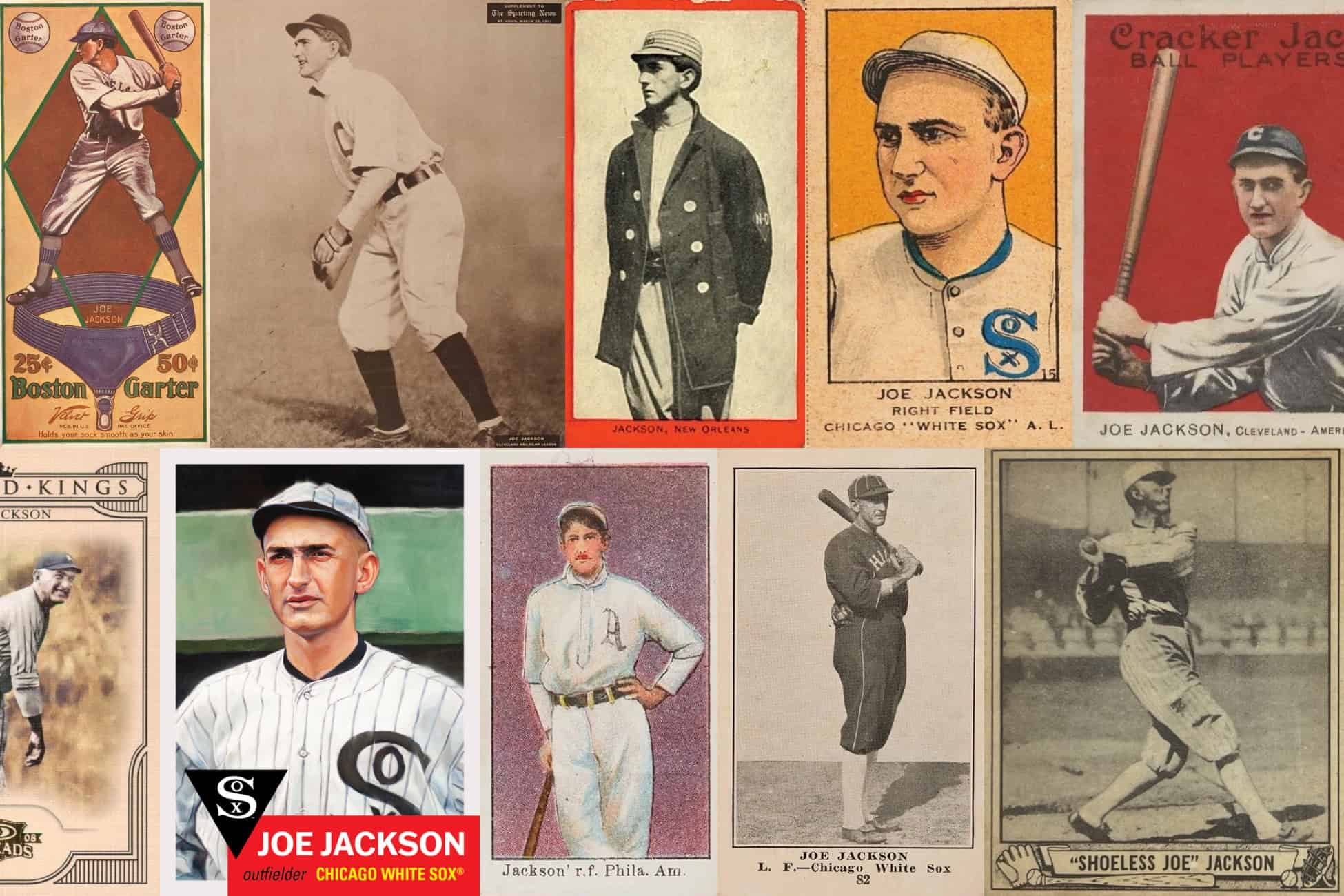

Few names in baseball history carry the mystique and controversy of Joseph Jefferson “Shoeless Joe” Jackson. The third-highest career batting average in Major League Baseball history (.356) belongs to a man banned from the game for alleged involvement in the 1919 Black Sox Scandal. This complex legacy has made Shoeless Joe Jackson cards some of the most sought-after and valuable in the hobby, with prices regularly reaching into six figures for authenticated examples.
For collectors, Jackson cards are connections to baseball’s deadball era, from questions of innocence and guilt that remain unanswered more than a century later, to one of the game’s most naturally gifted hitters. The scarcity of Jackson’s playing-day cards, combined with his banishment from organized baseball in 1920, has created a perfect storm for collectibility. Unlike peers who appeared in sets throughout the 1920s and beyond, Jackson’s card production window was remarkably narrow – essentially 1909 to 1920 – making each surviving example particularly precious to vintage collectors.
Life and Career of Shoeless Joe Jackson
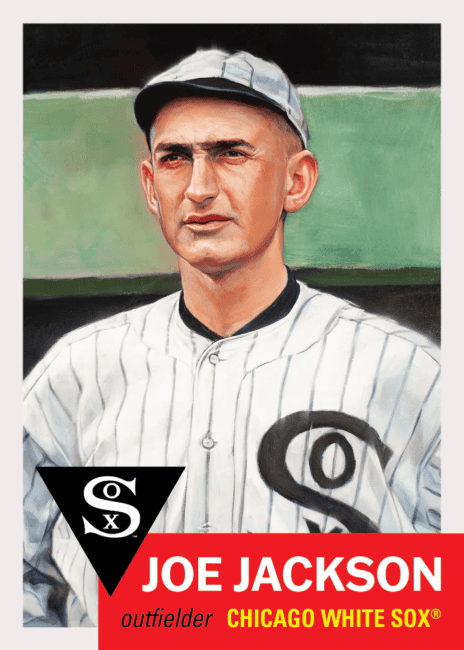
Joseph Jefferson Jackson was born on July 16, 1887, in Brandon Mills, South Carolina. Starting work in textile mills at age seven, Jackson never received formal education and remained functionally illiterate throughout his life. This lack of literacy would later have significant implications for autograph collectors, as we’ll explore. Despite these humble beginnings, Jackson’s baseball talent was undeniable. He earned his famous nickname as a teenager when he played a game in his stocking feet because new cleats had given him blisters.
Jackson began his professional career with the Greenville Spinners in 1908, the same year he married Katie Wynn. Jackson was traded to the Cleveland Naps (later Indians) in 1910, where he finally blossomed, after brief stints with the Philadelphia Athletics. In 1911, his first full major league season, Jackson batted an astounding .408 – still a record for rookies. He followed this with .395 and .373 seasons, establishing himself as one of baseball’s premier hitters. Babe Ruth himself later credited Jackson with influencing his batting style. He said Jackson was “the guy who made me a hitter.”
In 1915, Jackson was sold to the Chicago White Sox for what was then the highest transfer fee in baseball history. He helped the team win the 1917 World Series. Then, he was a key player when they returned to the Fall Classic in 1919. That series against the Cincinnati Reds would prove fateful. Despite Jackson’s .375 average (the highest on either team) and 12 hits (a World Series record at the time), the White Sox lost. Within a year, eight players, including Jackson, allegedly conspired with gamblers to throw the series.
Commissioner Kenesaw Mountain Landis banned all eight players for life in 1920, ending Jackson’s career at age 33. Jackson maintained his innocence until his death on December 5, 1951, in Greenville, South Carolina. The debate over his guilt continues today. Historians pointing to his strong performance as evidence of innocence, while others note the circumstantial evidence against him. In May 2025, MLB posthumously reinstated Jackson, making him eligible for Hall of Fame consideration.
Top 5 Shoeless Joe Jackson Cards
1909-11 E90-1 American Caramel – The Rookie Card
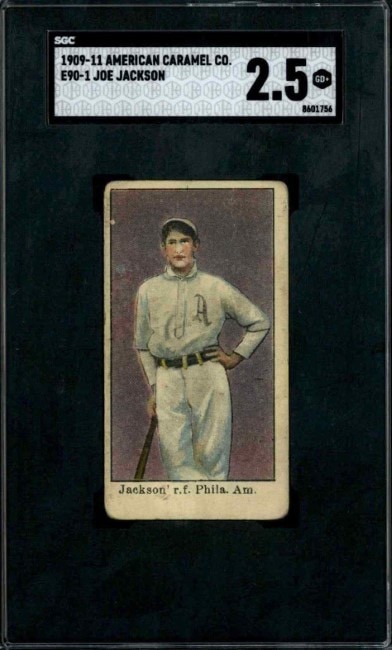
Widely considered Jackson’s official rookie card, the E90-1 American Caramel issue is the most valuable Jackson card in existence. These cards were packaged with hard caramel candy and typically measure approximately 1.5″ by 2.75″. The set includes other legends like Ty Cobb and Honus Wagner, but the Jackson card reigns supreme.
In 2016, a PSA 8 example sold for a record $667,189 through SCP Auctions. This was one of just two examples graded that high by PSA, with none graded higher. Even lower-grade examples command serious money. PSA has graded around 80 Jackson E90-1 cards. Most are in poor to fair condition, making any well-preserved example extraordinarily valuable. Collectors should budget $50,000+ even for heavily worn examples, with mid-grade specimens (PSA 3-4) easily exceeding $100,000.
1910 T210 Old Mill – The Minor League Gem
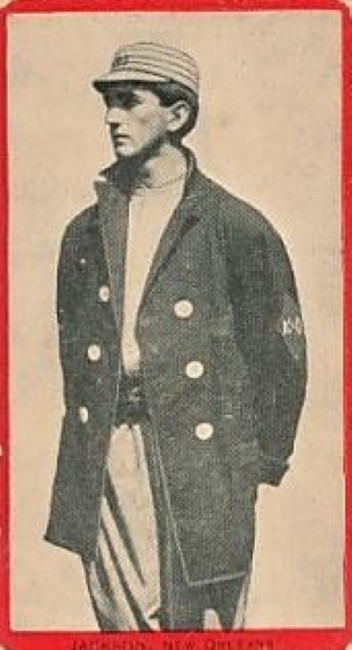
The T210 Old Mill series might feature minor league players, but Jackson’s card from this set is anything but minor in terms of value. This card depicts Jackson during his time with the New Orleans Pelicans between his stints with Philadelphia and Cleveland. With distinctive red borders, these cards were distributed in Old Mill cigarette packs.
In May 2020, a PSA 3.5 example sold for $492,000 after being discovered in a North Carolina family’s collection. It had been untouched for 110 years. PSA estimates even a VG (Very Good) condition card at around $250,000. The T210 Jackson is one of the rarest tobacco cards from the pre-war era. Only a handful of examples known to exist. Its rarity rivals the famous T206 Honus Wagner, making it a true holy grail for vintage collectors.
1915 Cracker Jack #103 – The Most Beautiful
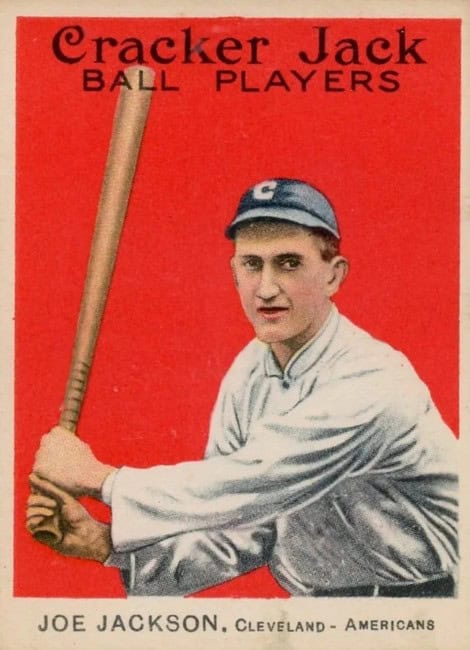
Many collectors consider Jackson’s Cracker Jack card his most aesthetically pleasing issue. The card features stunning artwork of Jackson in his batting stance against a rich red background. Unlike the 1914 Cracker Jack cards (which came directly from boxes and often show caramel staining), the 1915 versions are typically found in better condition. Collectors could order complete sets by mail for 25 cents and two box tops.
In December 2024, an SGC 9 example sold for a record $504,000 through Heritage Auctions. This matched the record for any 1915 Cracker Jack card. Prior to this sale, an SGC 8.5 example had sold for $336,000 in February 2024. PSA 8 examples have sold in the $107,000-$213,000 range in recent years, while PSA 3 copies still fetch around $60,000-$67,000. The card’s combination of eye appeal and relative availability (under 200 total examples graded by PSA) makes it a cornerstone of any serious vintage collection.
1916 M101-4/M101-5 Sporting News
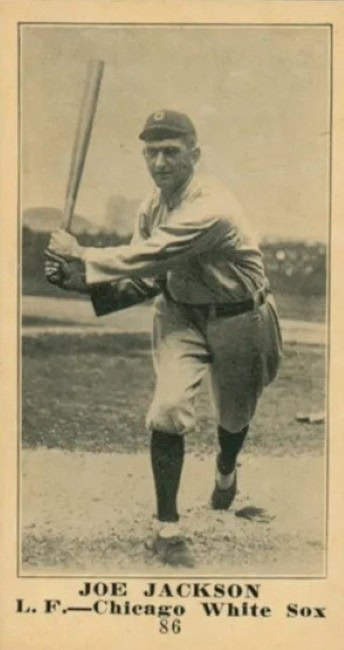
The M101 series cards were distributed by multiple companies, with Sporting News being among the most common issuers. These cards feature a sepia or black-and-white photograph of Jackson in his follow-through swing – an image inspired by a photo taken by Chicago photographer Felix Mendelsohn. Several variations exist with different advertiser backs, including Famous & Barr Co., Globe Clothing Store, and Indianapolis Brewing Co.
Values vary significantly based on the specific variation and advertiser, but examples regularly sell in the $10,000-$30,000 range for mid-grade copies. In 2022, a rare 1916 M101-4 with Gimbels advertising on the back, graded PSA 4.5, sold for $53,950 through Mile High Card Company. The M101 series offers collectors a more affordable entry point into Jackson’s playing-day cards while still maintaining historical significance.
1940 Play Ball #225 – The Post-Career Classic
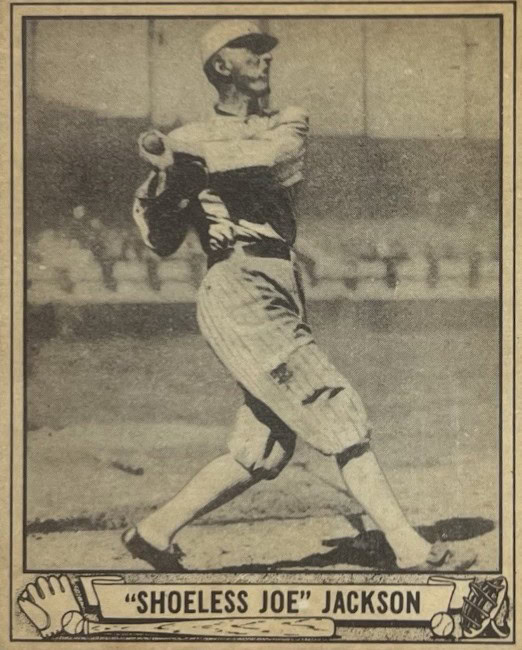
The 1940 Play Ball issue holds unique significance as Jackson’s most popular post-career card. Released 20 years after his banishment from baseball, this card (#225) appeared in the high-number series alongside other retired legends like Honus Wagner, Walter Johnson, and Christy Mathewson. The black-and-white photograph captures Jackson in a classic pose, though he never played during this era.
As a short-printed high-number card, the 1940 Play Ball Jackson is considerably scarcer than the lower-numbered cards in the 240-card set. PSA 7 examples have sold in the $5,000-$7,000 range, making this one of the more accessible vintage Jackson cards for collectors. Lower-grade examples (PSA 1-2) typically sell between $2,500-$3,500. The set suffers from a notorious condition issue – border toning that ranges from sepia to yellowish-brown – making clean examples particularly desirable. SGC 8 examples represent the highest grades typically seen and can command premium prices.
Shoeless Joe’s Autograph Market
Why Jackson Autographs Are So Rare
Shoeless Joe Jackson autographs represent the pinnacle of sports memorabilia collecting. Jackson was illiterate – a result of working in textile mills from age seven rather than attending school – and often hid this fact. He avoided signing his name whenever possible, making authentic Jackson signatures extraordinarily scarce.
According to PSA AutographFacts, fewer than two dozen authentic Jackson autographs are known to exist. These genuine signatures appear primarily on legal documents Jackson was required to sign: deeds to his house and liquor store, his driver’s license, his last will and testament, and a handful of other official papers. Only one authenticated Jackson-signed photograph exists – a 1911 image by photographer Frank W. Smith that sold for $1.47 million in 2021, setting the record for the most expensive signed sports photograph ever sold.
Even simple cut signatures command astronomical prices. In 2014, a Jackson signature clipped from an envelope sold for $41,825 at Heritage Auctions. The story behind this signature perfectly illustrates Jackson’s struggle with literacy: he had practiced signing his name on the envelope, hoping to fulfill a fan’s autograph request himself, but ultimately had his wife complete the task instead. A baseball signed by Jackson (along with four 1938 Detroit Tigers players) sold for over $50,000 in 2025, despite the signature being faint.
The Katie Jackson Secretarial Signature Issue
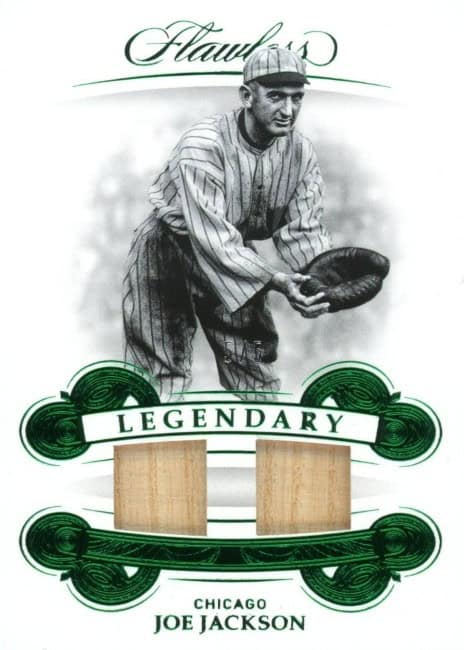
Jackson’s wife, Katie Wynn Jackson (1893-1959), played a crucial role in his life and business dealings. She managed their various enterprises and handled contracts. Most relevant to collectors – signed Joe’s name on his behalf for virtually all autograph requests. Katie was literate, and after Joe’s retirement from baseball, she signed almost every “Joe Jackson” autograph that left their possession.
This creates a significant authentication challenge. According to the Shoeless Joe Jackson Museum, visitors to the couple’s Greenville liquor store who requested autographed baseballs were often told by Joe to “come back tomorrow” – giving him time to have Katie sign the ball that evening. Katie continued responding to autograph requests even after Joe’s death in 1951. She sometimes explained that Joe had passed and offering to sign his name herself.
Distinguishing Authentic from Secretarial Signatures
Experts note several characteristics that help differentiate authentic Jackson signatures from Katie’s secretarial versions. Genuine Jackson signatures show difficulty connecting the letters – particularly the “J” and “A” and the “C” in “Jackson” – reflecting his struggle with writing. The signature often appears more labored and inconsistent. Katie’s signatures, by contrast, tend to be more fluid and consistent, showing the hand of someone comfortable with writing.
Collectors should approach any Jackson autograph with extreme caution. Only purchase items authenticated by reputable third-party services like PSA/DNA or JSA and, preferably, with more than one authentication. Even then, given the tiny population of authentic signatures, any Jackson autograph should be thoroughly researched and documented. Provenance is crucial – knowing the item’s history and chain of custody can help establish authenticity.
Current Autograph Market Values
The market for authenticated Jackson autographs remains incredibly strong. Just Jackson’s signature alone on a piece of paper is valued between $50,000 and $100,000. Documents signed by Jackson, such as his 1949 driver’s license (sold for $125,460 in 2021), command six-figure prices.
The scarcity cannot be overstated – you’re more likely to find a six-figure Jackson card than an authenticated Jackson autograph. For most collectors, Jackson cards represent the only realistic way to own a piece of his legacy.
Additional Insights for Collectors
Market Trends and Investment Potential
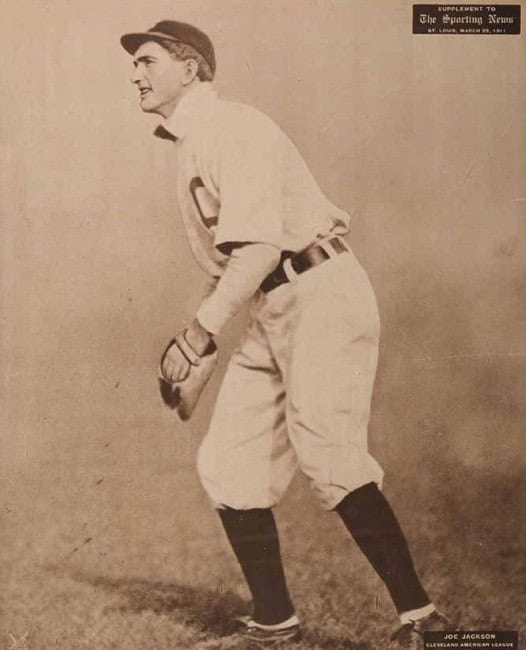
Understanding the value of Jackson cards requires appreciating their place in the broader vintage card market. His cards were produced during the tobacco and candy card era (roughly 1909-1920), when cards were premiums rather than standalone products. Survival rates for cards from this period are low due to the hazards of being stored alongside sticky food products, being handled by children, or simply being discarded. Combined with Jackson’s relatively short appearance window, this scarcity drives values.
Jackson cards have shown remarkable appreciation over the past decade. The record $504,000 paid for a 1915 Cracker Jack SGC 9 in 2024 represented a dramatic increase from the $106,000 paid for an SGC 9 example in 2016. Similarly, the T210 Old Mill example that sold for $492,000 in 2020 had comparable-grade examples selling for $600,000 just a year earlier, showing some price volatility but overall strong demand.
The 2025 reinstatement of Jackson by MLB has generated renewed interest in his cards and memorabilia. While he remains ineligible for Hall of Fame induction during his lifetime (he died in 1951), the removal from baseball’s ineligible list has sparked debate about whether he belongs in Cooperstown. This ongoing controversy actually benefits collectors, as it keeps Jackson’s name in the public consciousness and drives demand.
Joe Jackson Card Values
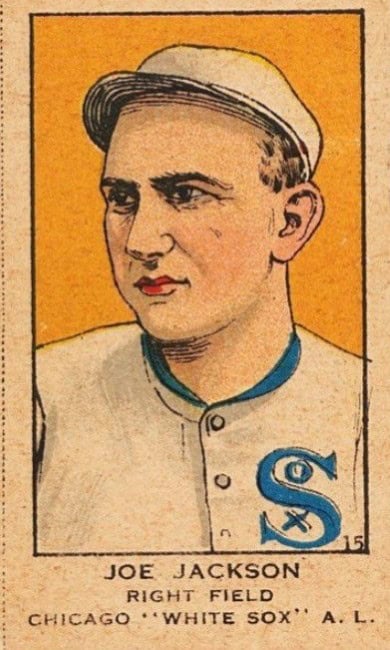
Given the values involved, Jackson cards have become targets for counterfeiters. The 1919-21 W514 strip cards are particularly vulnerable to forgery, as are some of the lesser-known issues. Always purchase Jackson cards that have been graded and authenticated by reputable third-party grading services like PSA or SGC. The cost of grading is minimal compared to the protection it provides against purchasing a fake.
Most collectors can’t afford six-figure cards. Fortunately, several options exist for those wanting to own a Jackson card without breaking the bank. Modern reprints and tribute cards from sets like 1992 Conlon Collection (valued around $1-2), various TCMA issues from the 1970s-1980s, and 1940 Play Ball cards (which feature deceased players and can be found for several thousand dollars) offer entry points into Jackson collecting.
Conclusion
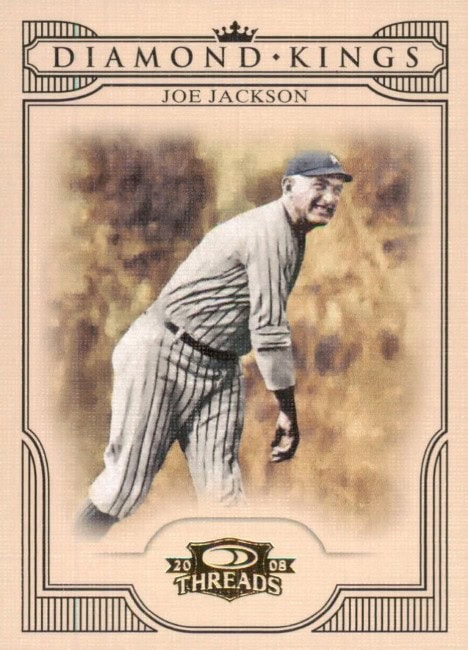
Shoeless Joe Jackson cards combine the appeal of deadball-era baseball, the mystique of one of the game’s greatest natural hitters, and the controversy of the Black Sox Scandal into cardboard and paper artifacts that command prices rivaling fine art. Whether you’re examining a museum-quality E90-1 rookie card or a more modest 1940s reprint, each Jackson card connects us to a player whose talent was undeniable and whose legacy remains complicated.
For serious collectors, Jackson cards represent both an investment and a piece of baseball history. The market has proven resilient, with top examples consistently appreciating over time. The narrow production window, combined with Jackson’s lifetime ban (now lifted posthumously), created artificial scarcity that benefits modern collectors but also requires careful authentication and significant financial resources.
As the debate over Jackson’s Hall of Fame eligibility continues, interest in his cards will likely remain strong. For those lucky enough to own authenticated examples – or skilled enough to identify undervalued specimens – Jackson cards offer both financial and historical rewards. In a hobby where condition is king and rarity commands premiums, Shoeless Joe Jackson cards check every box, ensuring their place among the most coveted collectibles in the sports world.
