
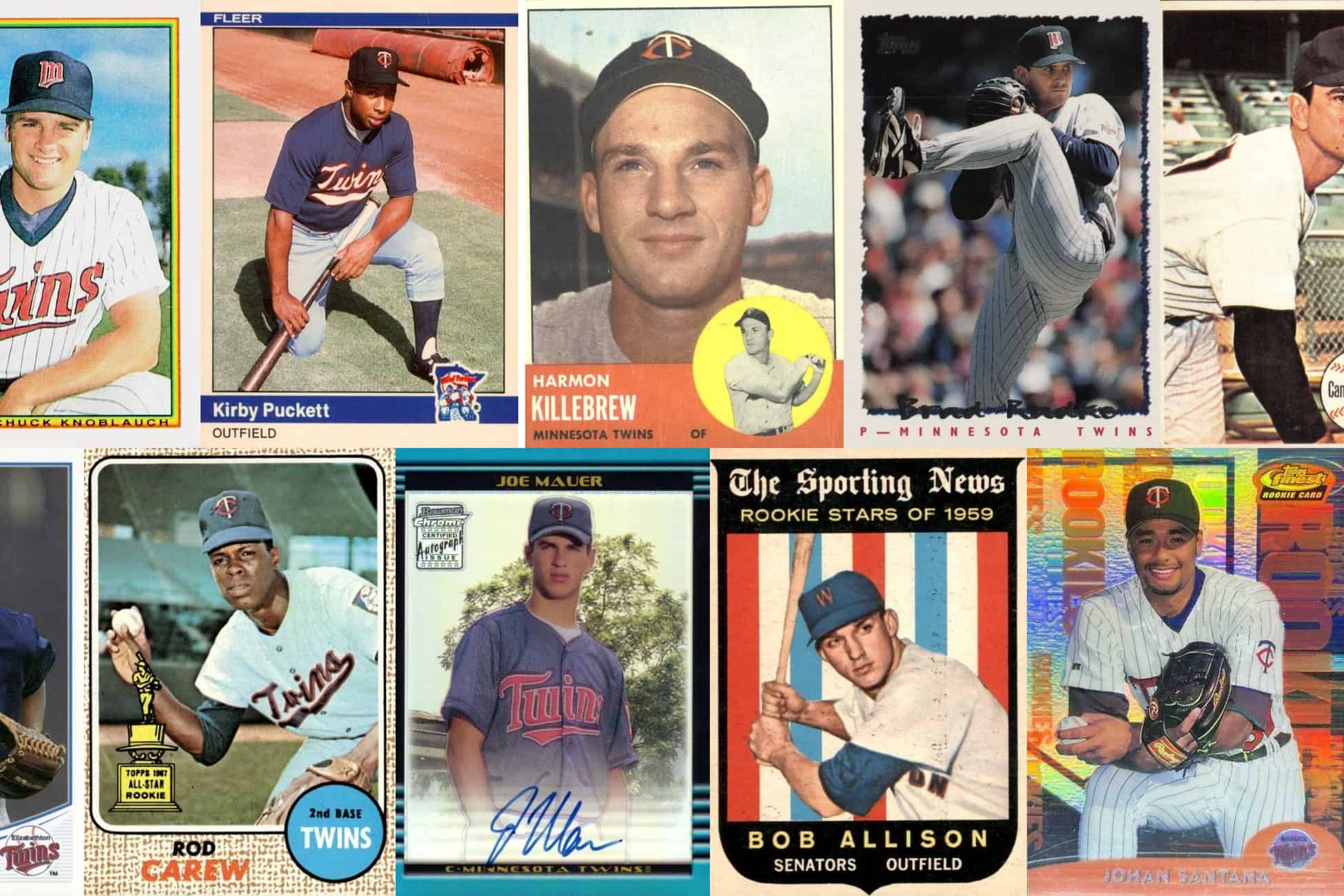

The Minnesota Twins occupy a unique space in the American League. Originally born as the Washington Senators in 1901, the franchise moved to the Upper Midwest in 1961. This relocation transformed a struggling club into a regional powerhouse. The Twins name reflects the twin cities of Minneapolis and Saint Paul, a nod to the deep community ties that define this organization. They’ve been the small market home for hundreds of players, who have adorned thousands of Twins baseball cards.
For Twins baseball card collectors, they offer a rich tapestry of cardboard history. From the early high-number Topps rookies of the 1960s to the sleek modern refractors of the 21st century, the hobby has always embraced the stars of the North.
The players on this list represent more than just numbers. They embody the resilience and technical skill often associated with Minnesota sports culture. Whether it is a gold glove outfielder or a precision-based contact hitter, these athletes established the standard for future generations. This countdown explores the legends who shaped the team and the iconic Twins baseball cards that keep their legacies alive in the hands of collectors today.
10. Bob Allison
Biography
Bob Allison was a cornerstone of the Twins power-hitting identity during their first decade in Minnesota. While he won his Rookie of the Year award in 1959 with the Senators, he remained a primary threat after the 1961 move. Allison was a three-time All-Star who possessed a rare combination of power and patience. He consistently drew walks, which helped him maintain a high on-base percentage during an era dominated by pitching.
Allison’s peak occurred alongside Harmon Killebrew and Tony Oliva, forming a middle-of-the-order trio that terrified opposing pitchers. He was an athletic outfielder with a cannon for an arm, famously making game-saving catches in the 1965 World Series. His leadership and versatility, including several seasons at first base, helped the young Minnesota franchise establish itself as an American League powerhouse. He remains one of the most respected figures in the organization’s Hall of Fame.
Iconic Card
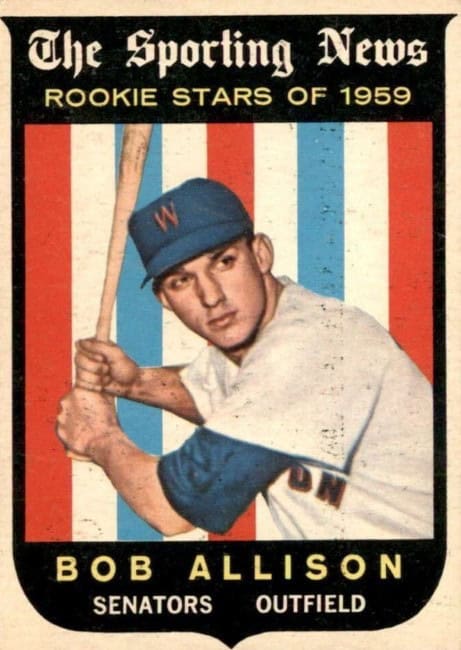
The 1959 Topps #116 is the essential rookie card for Bob Allison collectors. Even though it depicts him as a Washington Senator, it is the first major release featuring the man who would lead the Minnesota offense for ten years. A PSA 7 (Near Mint) copy of this card typically sells for approximately $120. Finding examples with perfect centering is the biggest challenge for this specific year, as the 1959 set is known for its narrow borders and frequent print tilts.
9. Johan Santana
Biography
Johan Santana was arguably the most dominant left-handed pitcher in baseball during the mid-2000s. After starting his career as a Rule 5 draft pick, he blossomed into a two-time Cy Young Award winner in Minnesota. His 2004 and 2006 seasons were masterclasses in pitching efficiency, as he led the league in strikeouts and ERA. Santana’s signature “circle changeup” was widely considered the most unhittable pitch in the game during his peak.
Santana provided the Twins with a true ace during their run of American League Central dominance. He was a three-time All-Star and a Gold Glove winner who consistently delivered high-inning totals with a low walk rate. His ability to elevate his performance in the second half of the season became a trademark of the “Johan era” in Minnesota. For fans who grew up watching the team in the Metrodome, Santana was the embodiment of pitching excellence and competitive fire.
Iconic Card
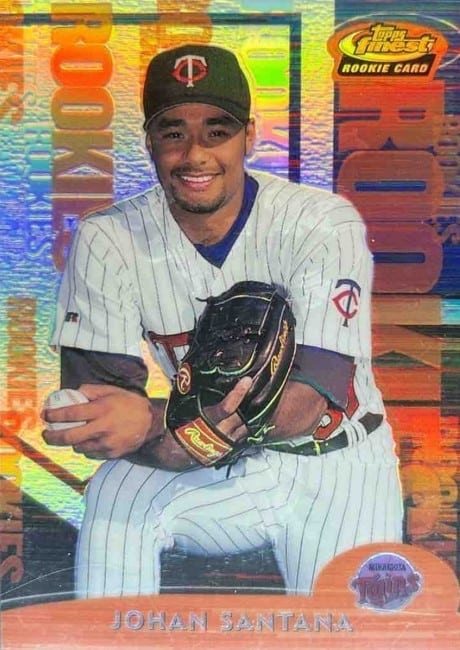
The 2000 Topps Finest #262 is the most prestigious rookie card for Santana. Unlike standard base cards, this was a limited-edition release, with only 3,000 copies produced. Because of its protective coating and high-end finish, finding a PSA 10 (Gem Mint) copy is a significant win for collectors. A PSA 10 version currently carries an approximate value of $200. It is a vital piece for anyone pursuing high-end Twins baseball cards, representing the early potential of a pitcher who completely redefined the franchise record books.
8. Kent Hrbek
Biography
Kent Hrbek was the quintessential hometown boy, growing up in Bloomington just minutes away from Metropolitan Stadium. He played his entire fourteen-year career in a Twins uniform, serving as the emotional heart of two World Series championship teams. Hrbek was an offensive juggernaut at first base, known for his power and an incredibly high baseball IQ. His grand slam in Game 6 of the 1987 World Series remains a peak moment in Minnesota sports history.
Beyond his bat, Hrbek was an exceptionally nimble defender. He frequently led the league in fielding percentage and was part of many crucial double plays that saved the 1991 championship run. Known for his gregarious personality and love for the outdoors, he resonated deeply with the local fanbase. Hrbek retired in 1994, but he remains a staple of the Minnesota community and a frequent guest at team events, always celebrated as the ultimate Twins pinstripe legend.
Iconic Card
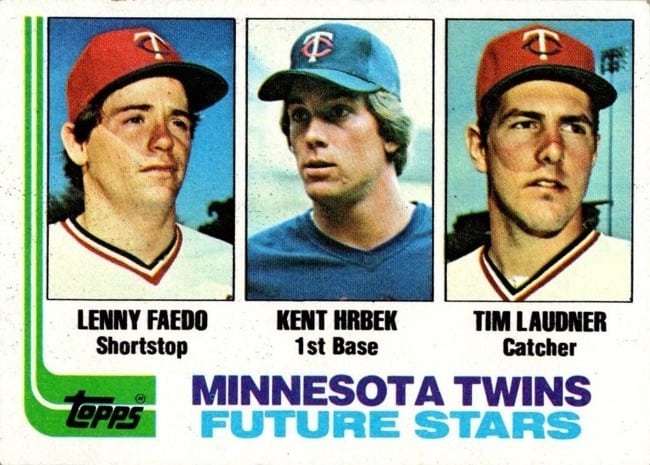
The 1982 Topps #766 is the primary rookie card for Hrbek. This card is easily identifiable by the “All-Star Rookie” trophy icon in the bottom corner, which signifies his second-place finish in the 1982 Rookie of the Year voting. In a PSA 10 (Gem Mint) grade, this card typically sells for approximately $120. It is a must-have for any collector focusing on the 1980s championship era, representing the start of a career that defined Twins baseball cards for a generation.
7. Tony Oliva
Biography
Tony Oliva arrived from Cuba and immediately became the most feared hitter in the American League. He won the Rookie of the Year award in 1964 and secured the first of his three career batting titles the same year. Oliva possessed a natural, fluid swing that allowed him to spray line drives into the gaps with ease. During his peak, he was a perennial All-Star and a constant threat in the middle of a powerful Twins lineup.
Severe knee injuries eventually slowed Oliva down, but he remained a productive hitter for fifteen seasons. He transitioned into one of the first great designated hitters in baseball history, helping the team remain competitive well into the 1970s. His recent induction into the Baseball Hall of Fame was a long-overdue validation of his incredible talent. Oliva remains a beloved figure in Minnesota, often seen at the ballpark sharing stories and mentoring younger generations of hitters.
Iconic Card
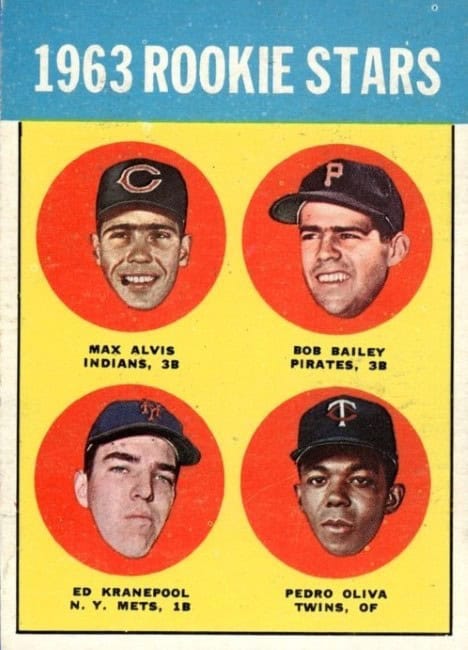
The 1963 Topps #228 “Rookie Stars” card is the most coveted item for Oliva fans, which lists him as Pedro Oliva (his younger brother’s name). It is a multi-player card, which was a common practice for Topps during that era. Finding centered copies is notoriously difficult, making high grades very valuable. A PSA 7 (Near Mint) version of this card usually sells for about $250. Because this card represents the start of a Hall of Fame career, its value has seen a steady increase as the hobby continues to recognize his greatness.
6. Jim Kaat
Biography
Jim Kaat, known as “Kitty,” was a model of durability and defensive excellence for fifteen seasons with the franchise. He began his journey with the Senators in 1959 and successfully transitioned with the team to Minnesota. Kaat was a workhorse on the mound, frequently surpassing 200 innings pitched per season. His 1966 campaign was legendary, as he won 25 games and finished second in the Cy Young Award voting while leading the league in complete games.
Beyond his pitching prowess, Kaat was arguably the greatest defensive pitcher of his era. He earned twelve consecutive Gold Glove Awards while playing for the Twins, setting a standard for athleticism at the pitcher position. His ability to finish his delivery in a ready position made him an extra infielder. Kaat was a key component of the 1965 American League Championship team, providing the veteran leadership that helped the young Minnesota franchise reach the national stage.
Iconic Card
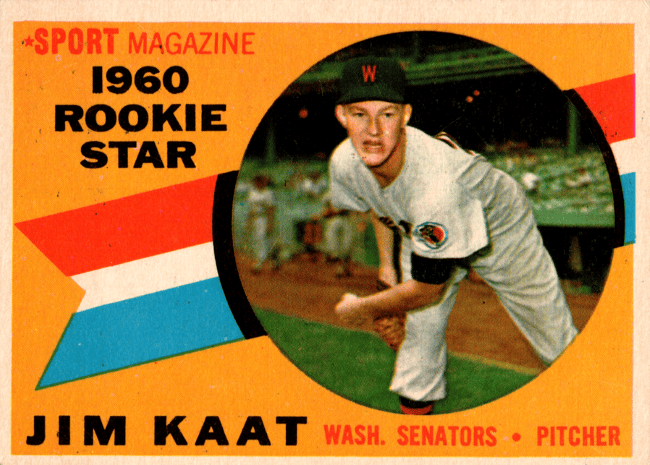
The most iconic card for Kaat is his 1960 Topps #136 rookie card. While it features him in a Washington Senators uniform, it represents the beginning of his journey with the organization that became the Twins one year later. In a PSA 8 (Near Mint-Mint) condition, this card typically commands a value of approximately $450. Higher grades are exceedingly rare and can fetch significantly more from specialists seeking to complete high-grade vintage sets from the early 1960s.
5. Brad Radke
Biography
Brad Radke served as the stabilizing force for the Twins pitching staff during one of the most volatile periods in team history. Debuting in 1995, Radke was known for his impeccable control and a changeup that left hitters guessing for over a decade. He rarely walked batters, consistently ranking among the league leaders in strikeout-to-walk ratio. His loyalty to the mid-market franchise was notable, as he spent his entire twelve-year career in a Twins uniform.
Radke was the bridge between the championship era of the early 90s and the divisional dominance of the 2000s. In 1997, he won 20 games for a team that finished well below .500, a feat that underscored his individual brilliance. Despite playing through various injuries toward the end of his career, he remained a primary starter until his retirement in 2006. Fans remember him as a quiet professional who let his performance on the mound speak for itself every fifth day.
Iconic Card
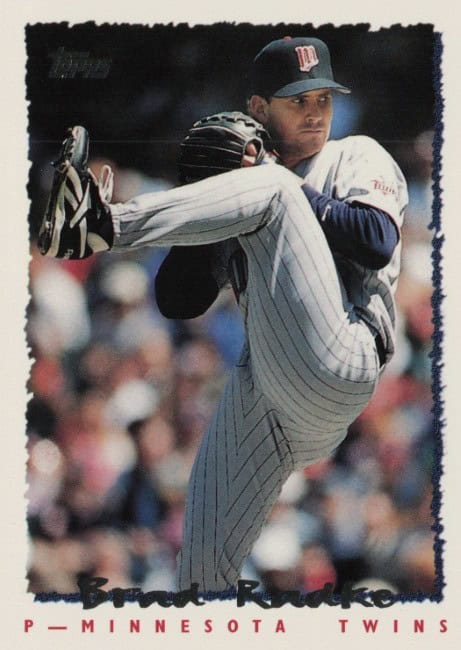
The 1995 Topps Traded #79T is one of the definitive Twins baseball cards for Radke collectors. This card captures him in the classic pinstriped home uniform of the era. Because it was part of a traded set, the population of high-grade copies is relatively stable. A PSA 10 (Gem Mint) copy of this card is quite affordable for most hobbyists, generally valued around $40. It is a perfect entry point for fans looking to celebrate a modern Twins legend without a massive financial outlay.
4. Joe Mauer
Biography
Joe Mauer is a hometown hero who lived every Minnesota kid’s dream. Growing up in St. Paul, he was a three-sport standout before being drafted first overall by the Twins in 2001. Mauer redefined the catcher position with his incredible hitting ability. He remains the only catcher in American League history to win three batting titles. His 2009 MVP season was a masterclass in hitting, as he batted .365 with 28 home runs while leading the team to a division title.
Mauer was known for his “quick hands” and an uncanny ability to drive the ball into the gaps. While concussions eventually forced a move to first base, his legacy as a premier backstop was already secured. He was a six-time All-Star and five-time Silver Slugger winner. In 2024, Mauer was elected to the Baseball Hall of Fame in his first year of eligibility, joining the elite ranks of Twins legends who spent their entire careers in Minnesota.
Iconic Card
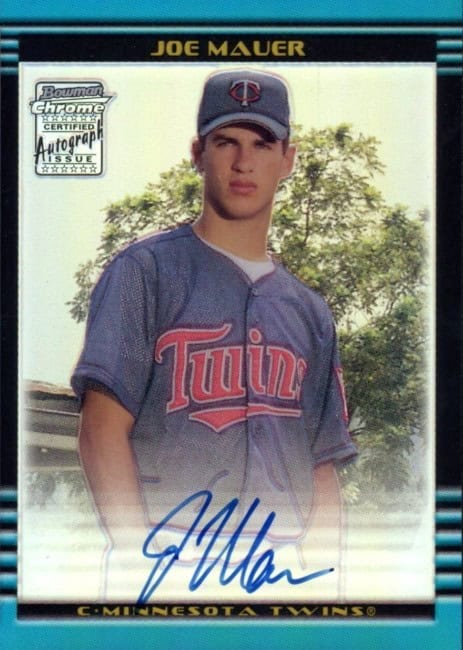
The 2002 Bowman Chrome #391 is the definitive Joe Mauer rookie card. Collectors specifically hunt for the “Refractor” versions of this card, which feature a rainbow sheen when held under light. A standard PSA 10 (Gem Mint) copy of the base Chrome card is valued at approximately $450. As a new Hall of Famer, interest in his early Twins baseball cards has reached a new peak, making Mauer a stable investment for long-term collectors.
3. Kirby Puckett
Biography
Kirby Puckett is perhaps the most iconic figure in Minnesota sports history. Standing only five feet, eight inches tall, he was a dynamo of energy and talent in center field. Puckett was a ten-time All-Star and won six Gold Glove Awards. He led the Twins to two World Series titles in 1987 and 1991. His performance in Game 6 of the 1991 World Series, which included a leaping catch and a walk-off home run, is cemented in baseball lore.
Puckett was more than just a power hitter. He was a consistent contact artist who led the league in hits four times. His career was tragically cut short by glaucoma in 1996, but his impact on the community never faded. He played his entire career in Minnesota and was a first-ballot Hall of Famer. The infectious smile and “never say die” attitude he brought to the clubhouse defined the winning culture of the Twins for over a decade.
Iconic Card
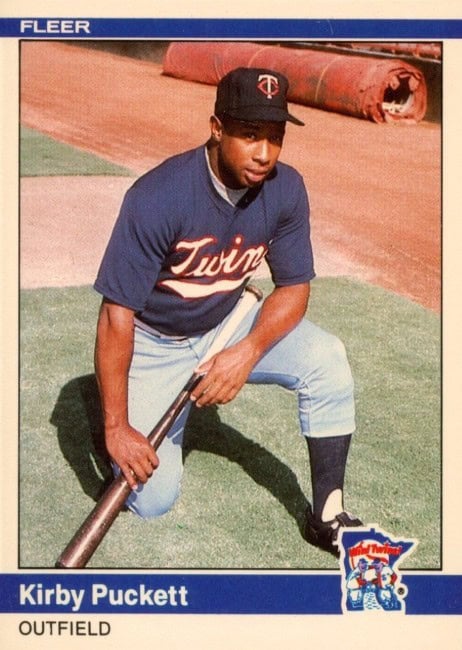
The 1984 Fleer Update #U-93 is the undisputed king of Kirby Puckett cards (and Twins baseball cards in general). This was an XRC (Extended Rookie Card) released in a limited-edition set at the end of the 1984 season. Because of its limited distribution compared to the standard 1985 rookie cards, it carries a significant premium. A PSA 9 version of this card is currently valued at approximately $800. For serious Twins collectors, this is the centerpiece of any high-end collection.
2. Rod Carew
Biography
Rod Carew was a wizard with a baseball bat. During his twelve seasons in Minnesota, he won seven batting titles, including a remarkable 1977 season where he hit .388. Carew had an unorthodox, crouched batting stance that allowed him to manipulate the barrel of the bat to hit the ball wherever the defenders weren’t. He was a perennial All-Star and the 1977 American League MVP.
Carew was also a daring baserunner, famously stealing home 17 times in his career, including seven times in 1969 alone. He was a complete offensive threat who used intellect and agility to beat his opponents. His transition from second base to first base later in his career showed his versatility and commitment to the team. Carew was a first-ballot Hall of Famer in 1991 and remains the standard by which all pure hitters in the Twins organization are measured.
Iconic Card
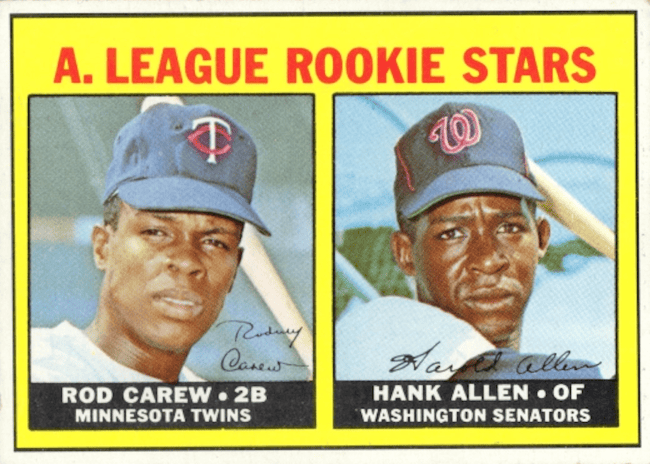
The 1967 Topps #569 is the rookie card that every Twins fan dreams of owning. It is a high-number card from the 1967 set, meaning it was produced in lower quantities than the cards released earlier in the year. This scarcity, combined with Carew’s legendary status, makes it a blue-chip hobby item. A PSA 7 (Near Mint) copy currently holds a value of about $1,200. It represents the pinnacle of Minnesota Twins cardboard and a fitting tribute to the franchise’s greatest player.
1. Harmon Killebrew
Biography
Harmon Killebrew was the face of the franchise when it moved to Minnesota in 1961. Known as “The Killer,” he was a gentle giant who let his bat do the talking. Killebrew was one of the most prolific home run hitters in baseball history, finishing his career with 573 round-trippers. He led the American League in home runs six times and was the 1969 American League MVP. His presence in the lineup turned the Twins into an immediate contender in the 1960s.
Killebrew’s power was legendary; he hit some of the longest home runs ever recorded at Metropolitan Stadium. Despite his nickname, he was known as one of the kindest players in the league, a true gentleman of the game. He was an eleven-time All-Star and was inducted into the Hall of Fame in 1984. The silhouette on the Major League Baseball logo is often rumored to be based on Killebrew, a testament to his status as the quintessential power hitter of his generation.
Iconic Card
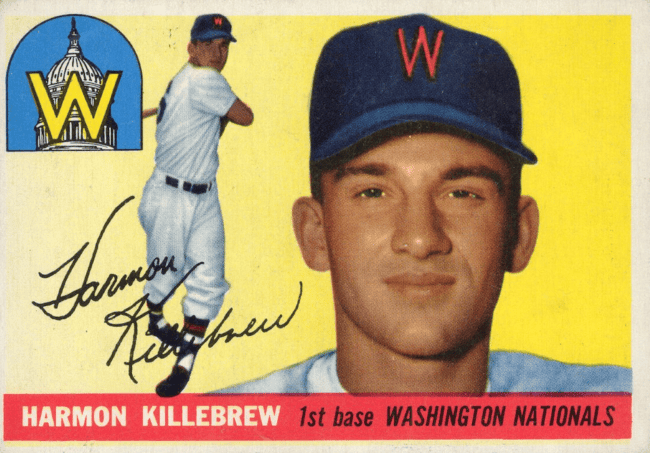
The 1955 Topps #124 is the rookie card for Killebrew. This horizontal layout is a favorite among vintage enthusiasts, featuring a portrait and an action shot of a very young Harmon. Because he debuted as a teenager with the Senators, this card precedes the move to Minnesota by six years. A PSA 6 (Excellent) copy of this card is valued at approximately $700. It is a cornerstone of any serious vintage baseball card collection.
Conclusion
The history of the Minnesota Twins is a story of transition, excellence, and community. From the early days in Washington to the championship glory in the Twin Cities, the franchise has been defined by players who combined individual brilliance with a team-first mentality. The ten men on this list were not just statistical leaders; they were the architects of a culture that values hard work and consistency. Their impact on the field helped build a loyal fanbase that spans across the Upper Midwest and beyond.
For the collector, these players offer a diverse range of opportunities. Whether you prefer the rugged beauty of 1950s vintage or the high-gloss finish of modern Chrome, the Twins’ legends provide plenty of targets. Each card is a tangible piece of history that connects us to the great moments of the past. As the team moves forward at Target Field, new stars will undoubtedly emerge to challenge these rankings, but the legacy of the original top ten remains secure.
Collecting the greatest Twins of all-time is more than just a financial investment; it is a way to preserve the stories of the men who made Minnesota baseball special. By focusing on WAR and iconic cardboard, we can appreciate the full scope of their contributions. These players set the bar high, and their cards will continue to be cherished by fans and collectors for generations to come. The pursuit of the perfect collection is a journey that celebrates both the game and the heroes who play it.
