
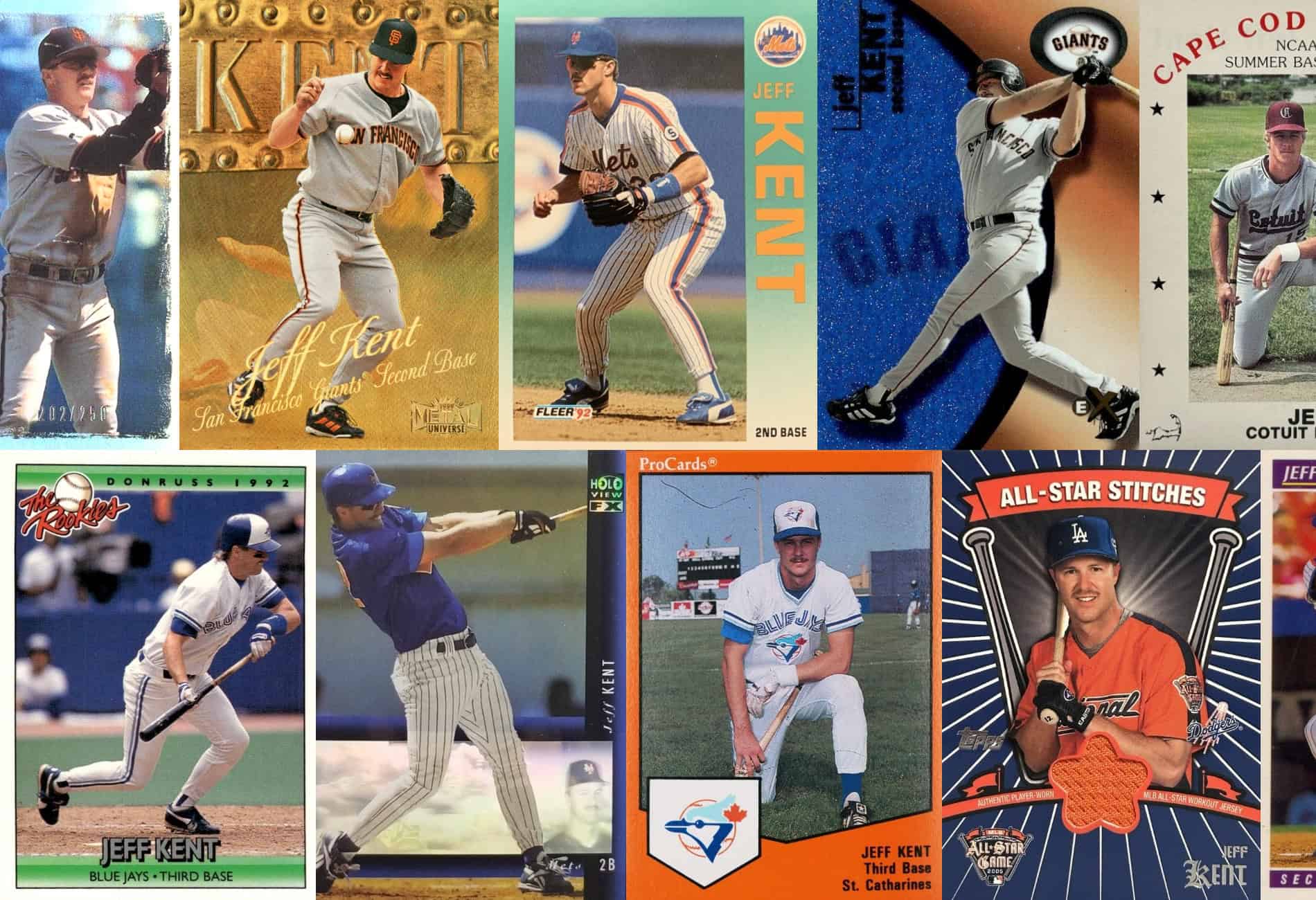
Few stories in recent hobby history have played out quite like Jeff Kent’s. For a decade, his name sat on the Baseball Writers’ Association of America ballot and generated debate without ever clearing the 75 percent threshold needed for Cooperstown. Then, in December 2025, the Contemporary Baseball Era Committee changed everything. Kent earned 14 of 16 possible votes and secured his spot in the Hall of Fame Class of 2026, set for induction on July 26 in Cooperstown alongside Carlos Beltran and Andruw Jones. Now let’s talk about Jeff Kent cards.
For collectors, that moment opened the door on a player who had long flown under the radar. Jeff Kent cards are genuinely interesting to pursue. His career spanned the junk wax era into the premium product age of the 2000s, giving collectors a wide range of options across price points. His best cards carry real historical weight – ownership of the all-time home run record for a second baseman is no small thing – and the HOF bump has given his market fresh energy heading into induction weekend.
Whether you are a longtime Kent fan who followed him through his Giants years, or a Hall of Fame completionist looking to add his key pieces, now is a great time to understand what is out there. This guide covers the man, the career, his path to Cooperstown, and the cards that matter most.
Jeff Kent: A Career Built on Run Production
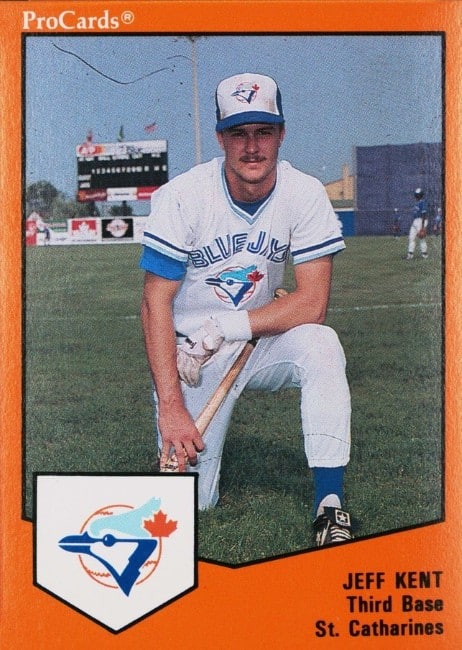
Jeff Kent was born on March 7, 1968, in Bellflower, California. He played high school baseball in Orange County and went on to play college ball at UC Berkeley, where his power potential was obvious from early on. Despite a standout collegiate career, he went in the 20th round of the 1989 MLB Draft, selected by the Toronto Blue Jays. That draft position may be one of the great underestimates in baseball scouting history.
Kent made his major league debut with the Blue Jays in 1992 before a midseason trade sent him to the New York Mets as part of the deal that brought David Cone to Toronto. He spent parts of five seasons in New York, establishing himself as a legitimate middle-of-the-order threat. By 1993, the profile was becoming clear: a second baseman who could hit for power and drive in runs at a rate the position rarely produced.
The Giants Dynasty
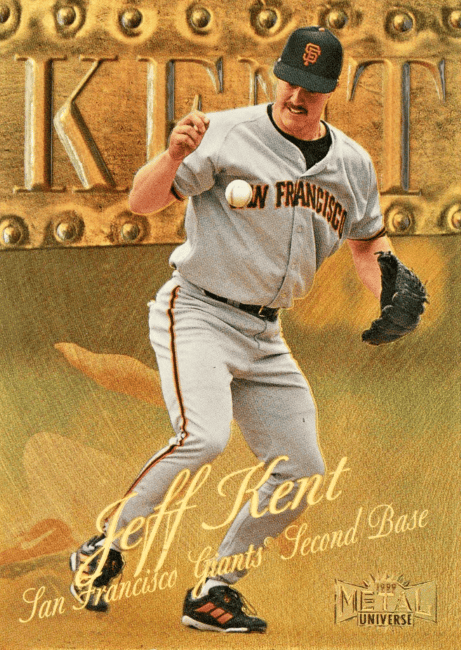
The defining chapter of Kent’s career began when the San Francisco Giants acquired him in a trade from the Cleveland Indians before the 1997 season. Over the next seven seasons alongside Barry Bonds, Kent became one of the most productive hitters in the National League. His peak came in 2000, when he batted .334 with 33 home runs and 125 RBI, earning the NL Most Valuable Player Award. It remains one of the finest offensive seasons a second baseman has ever produced.
He also played for the Houston Astros and Los Angeles Dodgers before retiring after the 2008 season. Across 17 seasons and 2,298 games, Kent finished with a .290 batting average, 377 home runs, 1,518 RBI, 560 doubles, and 2,461 hits. He won five Silver Slugger Awards and made five All-Star teams.
Jeff Kent’s Hall of Fame Path
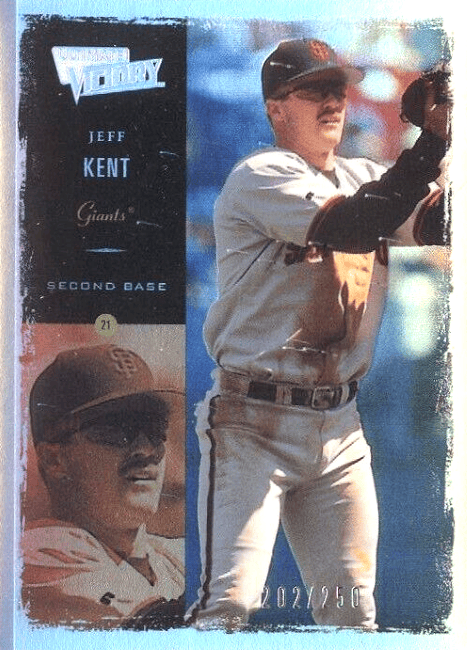
Kent’s road to Cooperstown was anything but smooth. He appeared on the BBWAA ballot for all ten years of his eligibility, topping out at 46.5 percent in 2023, well short of induction. Writers pointed to his defensive limitations and a personality that was famously prickly. He also spent his best years batting behind Barry Bonds, which sometimes caused his own production to be overlooked.
What eventually made the case undeniable was the record book. Kent hit 351 of his 377 home runs while playing second base, making him the all-time leader at the position. Robinson Cano sits second with 316. Kent’s eight seasons of 100 or more RBI are the most any second baseman has ever produced. Charlie Gehringer is second on that list with seven.
Comparing Kent to HOF Peers
The Contemporary Era Committee considered Kent alongside a stacked ballot that included Barry Bonds, Roger Clemens, Don Mattingly, and Dale Murphy. What separated Kent from that group was the combination of longevity and production at a position where power hitting is historically rare.
Among second basemen already in the Hall of Fame, the comparison holds up well. Ryne Sandberg hit 282 home runs in his career – productive for the position, but well below Kent’s total. Roberto Alomar, widely considered among the best at the position, hit 210. The counting stats argument is straightforward: no second baseman in history drove the ball like Kent. His .855 OPS and 30th-place all-time standing in doubles further strengthened the case. The committee ultimately agreed, electing him on an 87.5 percent vote.
The 5 Best Jeff Kent Cards to Collect
1992 Fleer Update #104 – His Top Rookie Card
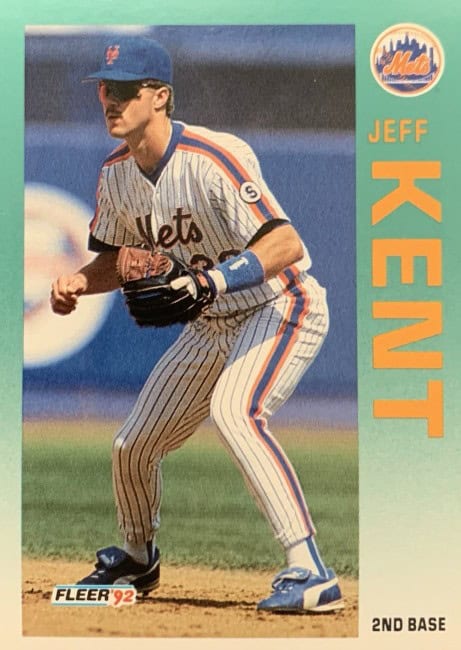
This is the Jeff Kent card that every serious collector wants. The 1992 Fleer Update set is well-regarded in the hobby for several reasons, including containing the Mike Piazza rookie card. Kent’s card shows him in a New York Mets uniform, issued after the Blue Jays dealt him midseason. It is widely recognized as his key rookie issue and has seen consistent growth since his HOF election.
The 1992 Fleer Update #104 (raw mint) sells for around $25-$30 per Beckett; PSA 10 copies trading in the $400 range or higher following his Hall of Fame election.
1992 Donruss Rookies #61 – Affordable RC Alternative
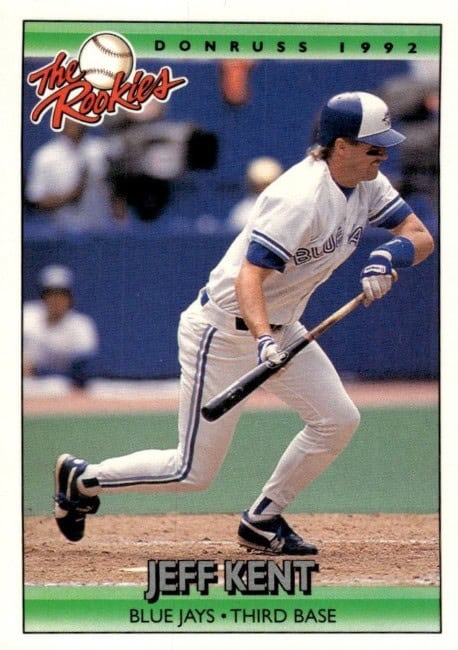
The 1992 Donruss Rookies set offers collectors a second legitimate rookie card option. It is more budget-friendly than the Fleer Update and makes a solid entry point for anyone building a Kent collection on a tighter budget. Both rookie cards depict Kent early in his career before the Giants chapter that defined his legacy.
1992 Donruss Rookies #61, ungraded is an accessible entry into Jeff Kent cards. It generally sells for under $10 in mint condition. PSA 10 copies under $125, so you can invest in the highest grade at a reasonable price.
1994 SP Holoview F/X #19 – A 90s Insert Done Right
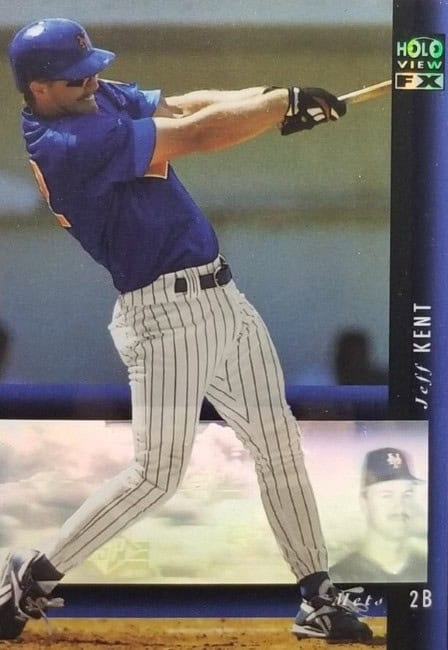
The Holoview F/X insert series from 1994 SP Baseball stands out as one of the more impressive inserts the hobby produced during that decade. Rather than using a single static photo, the holographic portion of the card displayed multiple images of the player, with facial expressions that shifted depending on the viewing angle.
Kent was actually not included in the base 1994 SP set, making this insert his only appearance in the product. That distinction, combined with the visual appeal of the holographic technology and the overall reputation of SP as a premium brand, makes this one of his most desirable non-rookie cards. It captures him during his productive Mets years and holds up beautifully as an example of mid-90s card design at its best.
2005 Topps Updates & Highlights All-Star Stitches #ASR-JK – An Easy and Affordable Relic
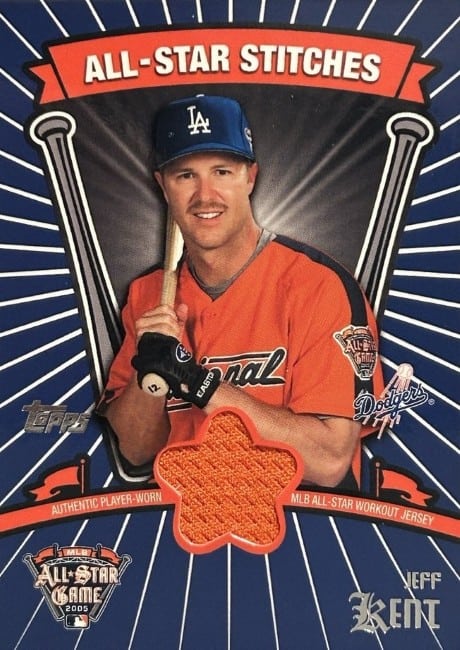
For collectors who want a relic in their Kent collection without spending a lot, this card is an attainable option. The All-Star Stitches insert from 2005 Topps Updates and Highlights features a swatch from the workout jersey Kent wore during that year’s All-Star festivities, representing one of his five All-Star selections. The swatch comes from an All-Star workout section and depicts Kent in his Dodgers jersey.
Copies turn up regularly with asking prices often starting at $5-10 ungraded, making this one of the most accessible memorabilia cards in the hobby for any player. It is a Group C pull from the set, meaning it came out of hobby packs at roughly one in every 41 packs. For a Kent collector building out their first serious run at the player, this is an affordable and satisfying box to check.
1988 P& L (Cape Cod League) #169 – The Pre-Rookie Gem
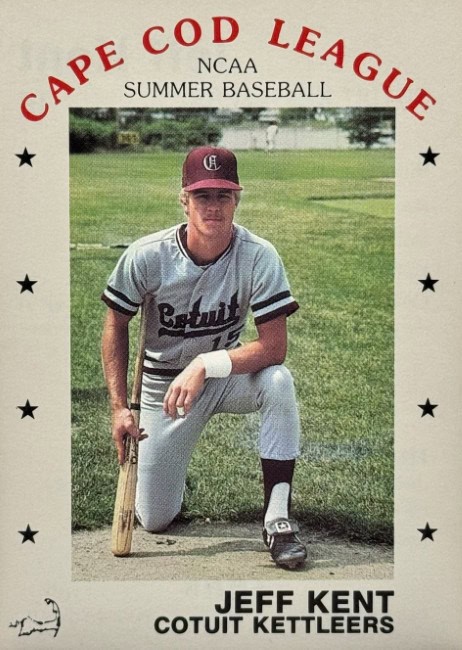
For the dedicated Kent collector, this card is a true chase piece. Issued while Kent played for the Cotuit Kettleers in the Cape Cod League during the summer of 1988, it captures him before he even became a professional. The P&L set also includes pre-rookie cards of Jeff Bagwell and Frank Thomas, giving it a remarkable lineup of future stars. High-grade copies of this card are genuinely rare and represent the top end of a Kent collection.
This is one of the most expensive Jeff Kent cards, because it’s not easy to find. Still, it is a 1980s card. PSA 10 copies have sold for over $275 even before the election.
Jeff Kent Card Values
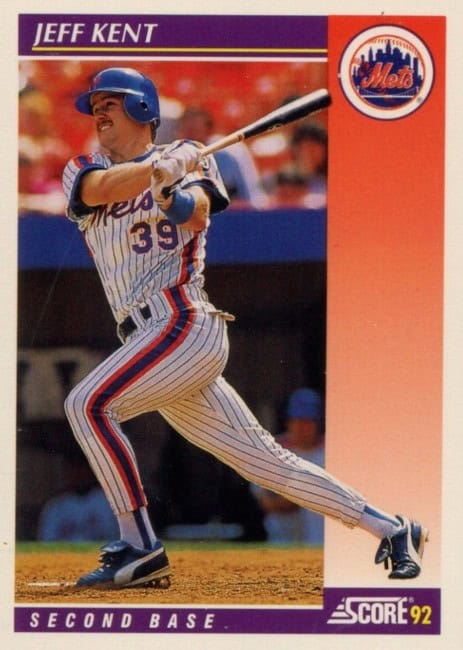
The market for Jeff Kent cards moved sharply in the weeks following his HOF election in December 2025, and values have continued to attract attention heading into the July 2026 induction ceremony.
Kent’s market benefits from having a modest total card catalog of meaningful issues. With Beckett listing over 3,800 total Kent items, there is no shortage of cards to find. But the key issues are well-defined and not overproduced at the high end. That makes chasing the top PSA 10 copies a focused and achievable goal.
One additional note for collectors: certified autographs of Kent from his active career are relatively scarce. He does not have a deep catalog of signed inserts from the 1990s and 2000s, which makes authenticated autographs from that era particularly worth pursuing when they surface.
Conclusion
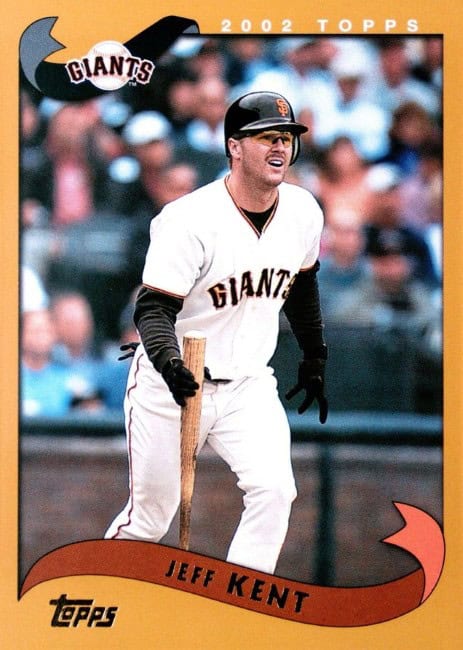
Jeff Kent’s Hall of Fame election is one of the better stories the hobby has seen in recent years. A player who spent a decade being underappreciated by voters finally received formal recognition that his numbers always warranted. The all-time home run record at second base, eight 100-RBI seasons, a National League MVP, and a career .290 average make for a Hall of Fame resume that holds up under any serious scrutiny.
For collectors, the timing is excellent. Kent’s card market had already been building momentum based on his stats and HOF candidacy. The election accelerated that, and the July 2026 induction ceremony provides another natural moment for increased interest. His rookie cards are genuinely interesting pieces from a key era in hobby history, and the scarcity of high-grade copies keeps the pursuit meaningful.
Whether you are targeting the 1992 Fleer Update as a cornerstone piece or chasing the 1988 Cape Cod League card as the crown jewel of a deep collection, Jeff Kent cards offer something for every type of collector. Now that he is officially headed to Cooperstown, the only question is how much longer these prices stay where they are.