
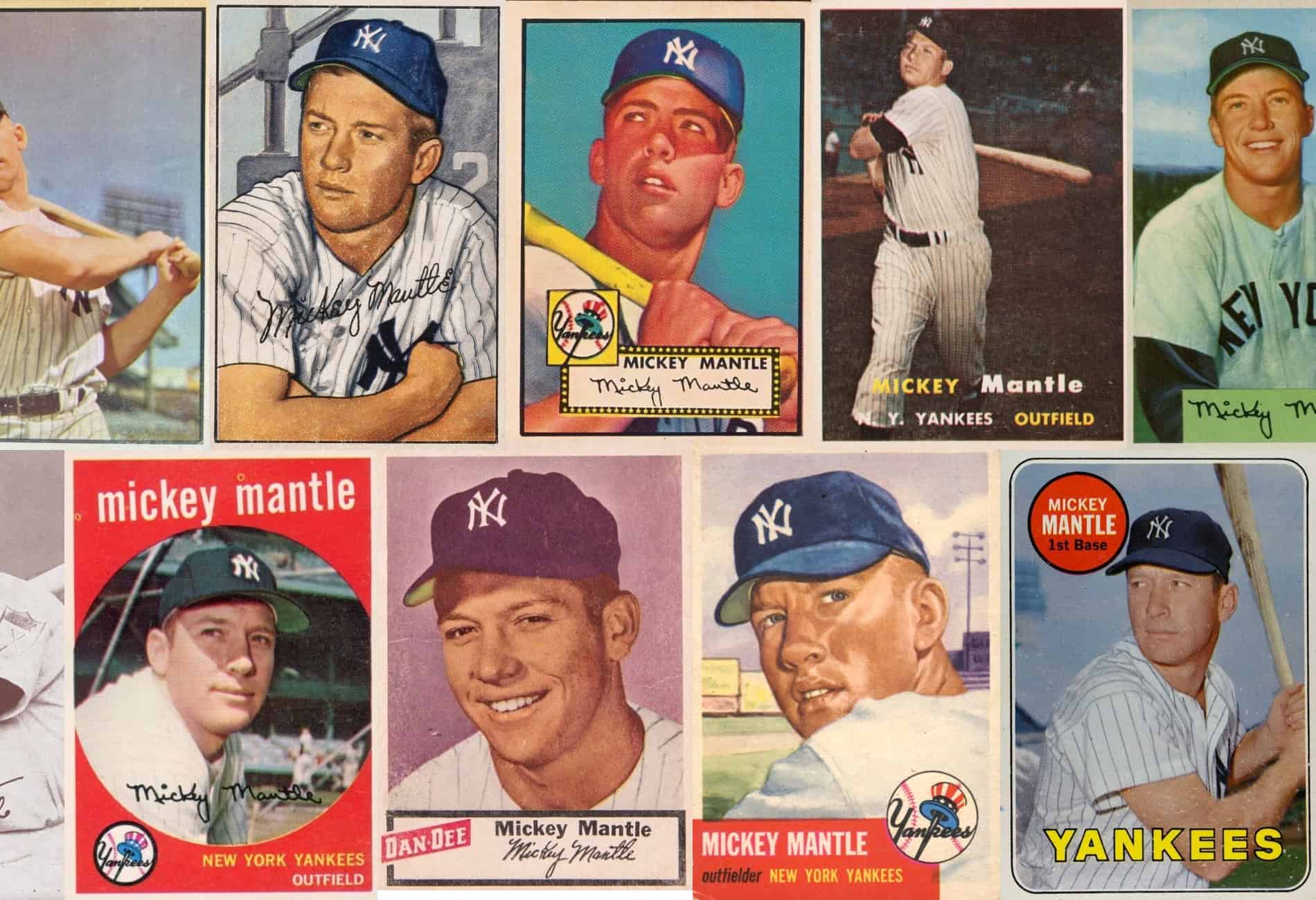

Few names in the baseball card hobby carry the weight of Mickey Mantle. From the moment Topps launched its first flagship set in 1952, The Mick stood at the top of the price guide. He never left. Flip through a vintage Beckett from any decade, page to a 1950s or 1960s set, and you almost always find the same thing: Mantle at the top of the price column. No other player from his era occupies that position with the same consistency.
His appeal is not accidental. Mantle was a switch-hitting center fielder who played 18 seasons with the New York Yankees. He earned three American League MVP awards, won seven World Series rings, and retired with 536 home runs. He was the face of baseball’s most storied franchise during the sport’s most romanticized era. Collectors who grew up in the 1950s and 1960s connected with him the way later generations connected with Ken Griffey Jr. – as the embodiment of the game at its best.
What makes building a Mantle collection especially interesting is the variety of the cards he left behind. The choices range from iconic mass-market Topps issues to quirky regional food promotions. Some entries on this list belong in museum displays. Others cost a few hundred dollars and belong on a collector’s desk. This ranked list covers 10 of the best, from a fan-favorite regional oddball all the way up to the most famous baseball card in hobby history.
#10: 1954 Dan-Dee Potato Chips Mickey Mantle
The Chips That Came With a Side of Cardboard
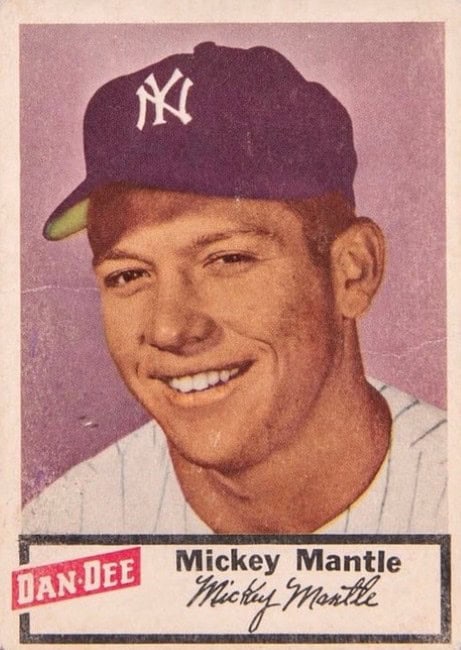
In 1954, Mantle had no Topps card. He was under a Bowman exclusivity agreement that year, which makes the regional issues from that season surprisingly important. Dan-Dee Potato Chips distributed an unnumbered 29-card set tucked inside chip bags across the mid-Atlantic region. Mantle is the key card in the set, and the circumstances of its distribution made survival in good condition nearly miraculous.
Chip oils soaked through the packaging regularly, staining cards and softening corners. Centering on surviving examples tends to run 60/40 or worse, and perforated edges are considered natural for the issue. PSA has graded fewer than 1,000 total copies, making this one of the rarest playing-era Mantle cards in existence. A PSA 7 example brought $16,538 at a Memory Lane auction, and top-grade copies have sold considerably higher.
This card earns its spot on the list as the quirky selection – it exists because someone thought potato chips and baseball cards made a natural pairing. Somehow, despite the odds, enough copies survived to remind collectors that Mantle’s 1954 season, when he batted .300 with 27 home runs and led the American League with 129 runs scored, happened to coincide with one of his most interesting and obscure card appearances.
#9: 1969 Topps Mickey Mantle White Letter Variation #500
The Walk-Off Home Run of His Card Career
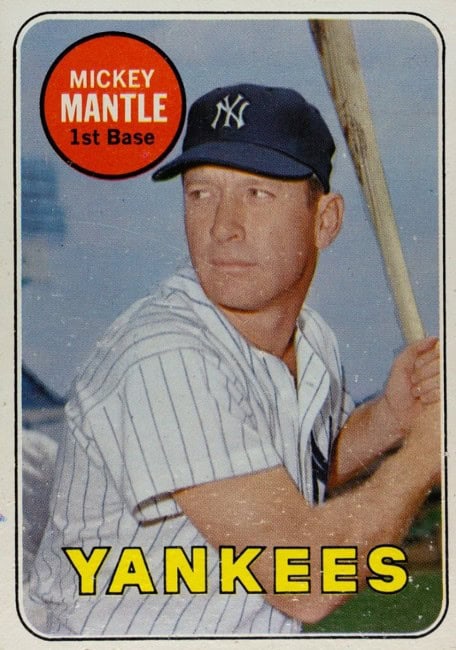
Mantle’s 1969 Topps base card #500 matters on its own terms – it is his final playing-era card, and the back displays his complete career statistics in a single satisfying block. But the white letter variation transforms a meaningful farewell into something genuinely special.
In standard form, the card prints Mantle’s name in yellow letters. A limited run from the fifth series replaced that yellow with white – and nobody can say for certain why. Some collectors believe it was a simple ink error. Others suspect it was an intentional move to drive pack sales. Whatever the cause, the card became one of the hobby’s most coveted printing variations. Around 23 cards from that fifth series carry white letter variants, but Mantle’s is by far the most valuable.
PSA data tells a dramatic story: roughly five times as many standard yellow-letter versions exist as white-letter versions. Just one PSA 10 exists, four PSA 9s, and 46 PSA 8s. A PSA 9 sold at Heritage Auctions in 2025 for $915,000. Raw white-letter versions in presentable condition typically sell in the $775-$850 range, making this accessible enough that serious collectors can enter the conversation without a seven-figure budget.
#8: 1957 Topps Mickey Mantle #95
The Ghost in the Batting Cage
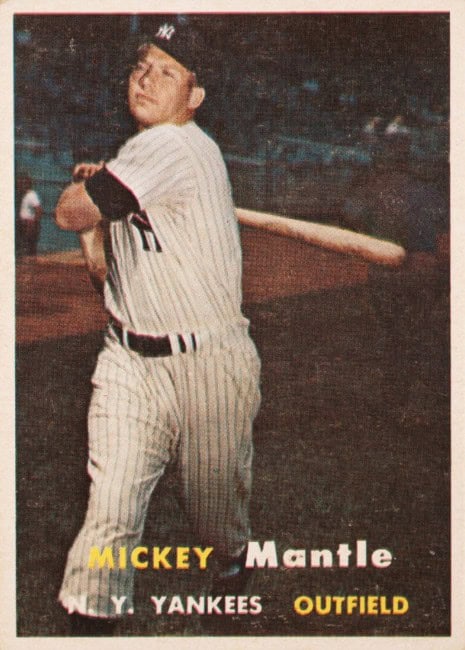
The 1957 Topps Mickey Mantle features one of the most beloved action shots in his entire Topps run – a full-body image of The Mick working through his left-handed swing. It captures Mantle at his statistical peak. In 1957, he posted a career-high .365 batting average, won his second consecutive AL MVP award, and put up a WAR of over 12.
The card carries an additional layer of intrigue for collectors who study it closely. Well-preserved examples reveal a ghost-like outline of another human figure at the tip of Mantle’s bat – likely a groundskeeper or photographer’s assistant who wandered into the frame at the last second. Some fans have called it the ghost of Babe Ruth, which is more poetic than accurate, but the mystery adds personality to an already handsome card.
High-grade specimens are genuinely scarce, with the top examples approaching $160,000. The 1957 set also features rookie cards of Frank Robinson and Brooks Robinson, giving the release important company. For collectors who want a Mantle that balances visual appeal, historical significance, and relative affordability compared to the earlier issues, the 1957 Topps is a natural target.
#7: 1956 Topps Mickey Mantle #135
Triple Crown Talent
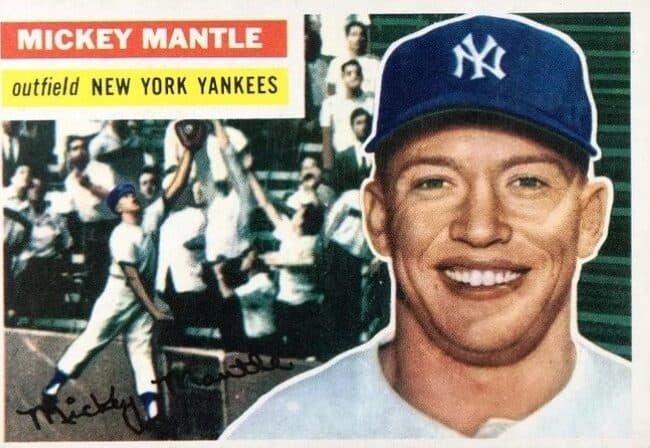
The 1956 Topps Mickey Mantle captures The Mick at the moment he announced himself as the best player in baseball. That year, he batted .353 with 52 home runs and 130 RBIs to claim the Triple Crown and his first MVP award. He also posted an OPS of 1.169. It was, by almost any measure, the greatest season of his career.
After a two-year absence from Topps products due to Bowman exclusivity, Mantle’s return to the brand made this card an event. The set includes an action shot that shows Mantle could beat opponents with his glove as well as his bat. The card also comes in gray-back and white-back variations, with the white back slightly harder to find.
PSA auction records show this card has generated over $8 million in total sales volume. Prices range widely by grade – a PSA 1 recently sold around $560, while a PSA 7 brought over $10,000. For collectors who want a legitimate vintage centerpiece at a price that does not require a loan, mid-grade examples of this card represent one of the best entry points in the entire Mantle catalog.
#6: 1953 Topps Mickey Mantle #82
Fine Art in a Topps Frame
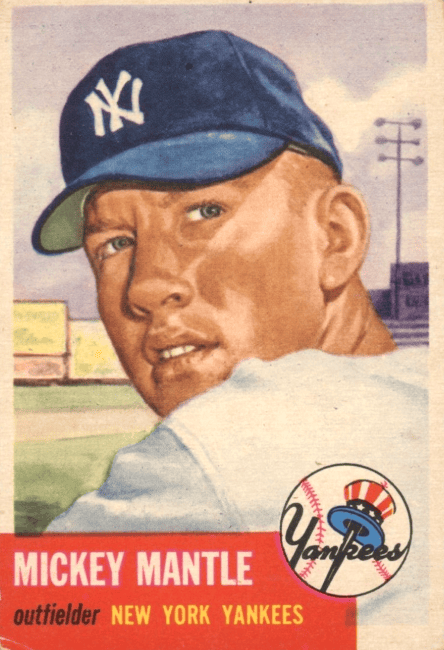
The 1953 Topps set stands as one of the most beautifully designed in hobby history, and Mantle’s card – a striking close-up portrait anchored by a red bottom border – ranks as one of its defining pieces. Topps artist Gerry Dvorak produced 274 oil paintings for the set, and the results look more like gallery art than bubblegum cards. The Mantle is the most coveted card in the release.
Condition presents a significant challenge. The red border at the bottom chips easily, centering on original copies tends to run off, and the extreme close-up format means any print defects land directly on Mantle’s face. High-grade examples are genuinely scarce. A PSA 9 has sold for over $300,000, and a PSA 8 brought $75,808 at Memory Lane. PSA has recorded nearly $9.8 million in total sales volume for this card.
The 1953 set also includes the first year Topps added biographical notes and trivia questions to card backs, making it a richer product than the 1952 flagship. Mantle batted .295 with 21 home runs that year – productive, but still a season or two before his full emergence as the game’s dominant force. The card benefits from that gap: this is Mantle still becoming great, captured in a design that has aged beautifully.
#5: 1952 Bowman Mickey Mantle #101
The One That Gets Overlooked
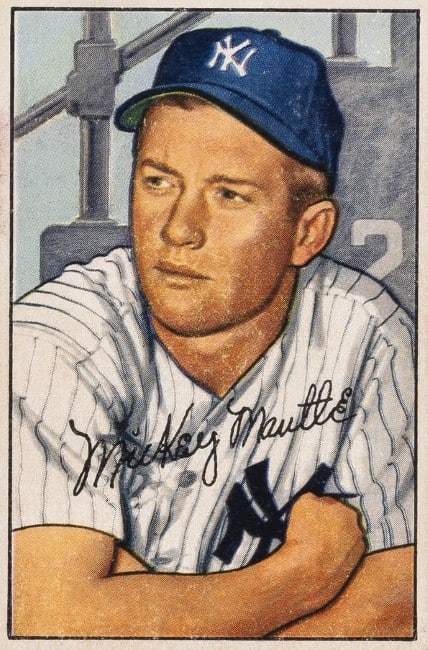
In 1952, the hobby offered two Mantle cards. One of them became the most famous baseball card in history. The other – the 1952 Bowman #101 – tends to get overshadowed despite being a genuinely remarkable card. That relative obscurity may make it the most undervalued card on this list.
The 1952 Bowman Mantle features a vertical layout with vivid painted artwork that shows the young Yankee in his classic pinstripes, complete with a facsimile autograph across the chest. It is, by many accounts, the best-looking of his Bowman issues. The card was part of the scarcer high series, which adds to its rarity. Centering challenges and gum stains on the reverse affect the graded population, making pristine examples especially hard to source.
Compared to the 1952 Topps, this card delivers an earlier, equally stunning portrait of Mantle at a fraction of the price. Collectors who want the experience of owning a spectacular early Mantle without spending seven figures will find this card rewarding. It offers the same vintage Bowman aesthetic that defines so much of early 1950s card art, in a smaller format that somehow makes the painted image feel even more intimate.
#4: 1955 Bowman Mickey Mantle #202
The Television Set Card
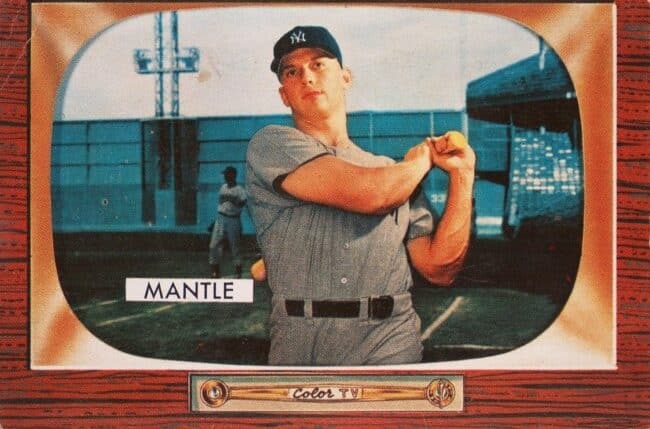
The 1955 Bowman set is instantly recognizable for one reason: every card is designed to look like a television screen. Bowman framed each player photo inside a rounded rectangle that mimics the cathode-ray tube TVs that were transforming American living rooms at the time. It is one of the most creative and era-specific designs in hobby history, and Mantle’s card is the most valuable in the set.
The card arrived during a transitional moment for Bowman. The company was one year away from being acquired by Topps, and the 1955 release was its final stand as an independent producer. The TV-screen concept was a genuine creative swing, and it paid off visually. Mantle appears in a clean portrait shot inside the simulated screen, looking relaxed and confident – a young star who knew exactly where his career was heading.
Condition challenges are real but manageable compared to some earlier issues. The wood-grain border that surrounds the TV frame shows wear at the corners, and print quality varies across the run. High-grade examples are scarce. A PSA 9 has sold for over $100,000, and PSA 8 copies regularly trade in the $20,000 to $30,000 range. Mid-grade examples offer collectors a legitimate entry point – a PSA 5 or PSA 6 can be acquired for well under $5,000, making this one of the more accessible cards on this list relative to its visual and historical appeal.
For collectors who want a Mantle that doubles as a conversation piece – something that prompts non-collectors to ask questions the moment they see it – the 1955 Bowman television card is hard to beat.
#3: 1953 Bowman Color Mickey Mantle #59
Photography Arrives at the Party
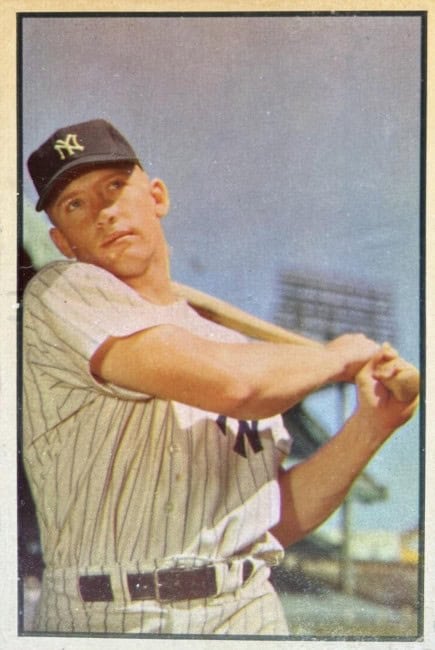
The 1953 Bowman Color set introduced full-color photography to mainstream baseball cards, and the result was revelatory. Unlike the painted portraits of earlier years, these cards showed players as they actually looked – real faces, real moments, real texture. Mantle’s card features one of his most iconic early images: a full swing follow-through that captures the raw power that made him famous.
The card’s design is deliberately minimal. No player name, no team, no position appears anywhere on the front – just the photograph, filling the entire card face with Mantle in motion. That restraint makes it feel modern even today. It also means that any print defect or centering issue lands on the image itself, which drives the scarcity of high-grade examples. Only one PSA 10 exists, and nine copies have received PSA 9 grades.
A PSA 9 example sold for $195,484 at Memory Lane, proof that the market treats this card with the same seriousness as the major Topps and Bowman issues. Collectors have recognized what the 1953 Bowman Color set offers: genuine photographic beauty at a time when the rest of the industry was still working in paint. Mantle’s card in this set stands as a turning point in what baseball cards could look like.
#2: 1951 Bowman Mickey Mantle Rookie Card #253
The True Rookie
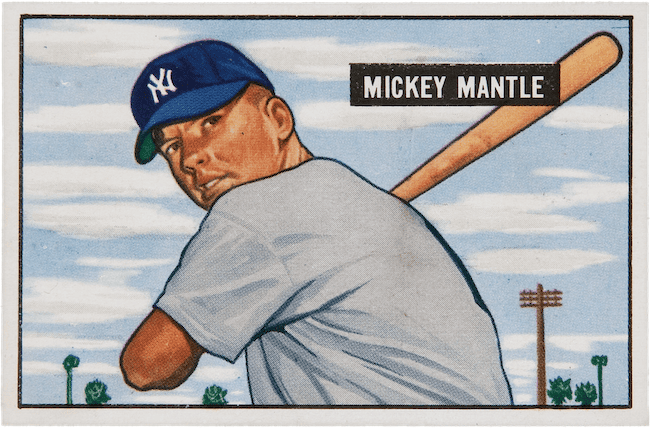
Here is where the hobby’s most famous misconception comes into focus: the 1952 Topps Mickey Mantle is not his rookie card. The true rookie – the first card ever produced featuring Mickey Mantle – comes from the 1951 Bowman set. Card #253 shows a young, fresh-faced Mantle in a horizontal layout with painted artwork and the kind of classic Bowman aesthetic that makes early 1950s cards so visually distinctive. He appears wearing uniform number 6, as he did in his earliest Yankee days before inheriting number 7.
The card comes from the scarcer high series of the 1951 Bowman set, which means original print runs were limited even before 70-plus years of attrition. PSA has graded fewer than 2,000 total copies. The population breakdown at the top is startling: just one PSA 10 exists, owned by Arizona Diamondbacks principal owner Ken Kendrick, and only nine PSA 9s have been certified. A Type I photo used as the reference image for this card sold for $843,750 at auction in 2024, illustrating the depth of collector interest in every artifact connected to it. A top-condition copy sold in January 2022 for approximately $3.2 million.
For collectors who care about the true meaning of a rookie card – the first time a player appeared on a card – the 1951 Bowman is the only place to start. That it is also a beautiful, historically rich card from the sport’s most romanticized collecting era only adds to its appeal.
#1: 1952 Topps Mickey Mantle #311
The Hobby’s Holy Grail
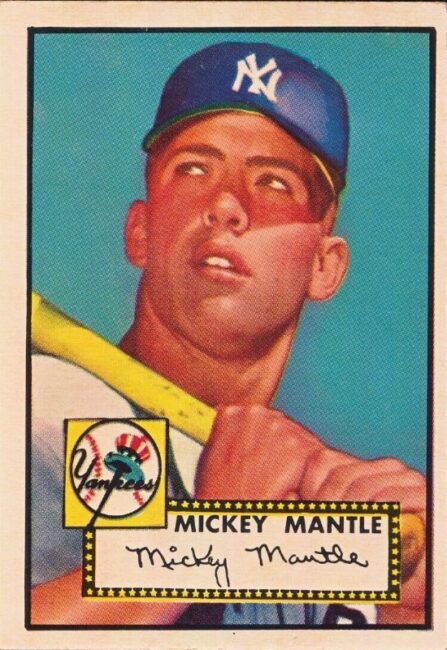
This is the undisputed king. The 1952 Topps Mickey Mantle #311 is not simply the most valuable Mantle card – it is arguably the most famous baseball card in hobby history. Some collectors even suggest it has surpassed the T206 Honus Wagner as the singular defining piece of the entire collecting world. Whether or not that argument holds, one thing is beyond debate: this card changed everything.
In August 2022, a copy graded SGC 9.5 sold through Heritage Auctions for $12.6 million. It was the highest price ever paid for a baseball card. The card’s owner, collector Anthony Giordano, had held it for decades while turning down multimillion-dollar offers. The top PSA 10 example, owned by collector Marshall Fogel, has reportedly received offers of $30 million. Just three PSA 10 copies exist.
The card belongs to the high series of Topps’ first major flagship set, which means it was distributed late in the season when collector interest had waned. Poor sales left cases sitting in a warehouse. Allegedly, company co-founder Sy Berger eventually arranged for hundreds of unsold cases to be dumped into the Atlantic Ocean. That legend, which Berger confirmed in a 2001 interview, has contributed to the card’s mystique even as it makes historians wince. The image itself shows a young Mantle – 19 years old at his first spring training with the Yankees – looking every bit the part of a future legend. Centering is notoriously difficult on this issue, and even low-grade, heavily worn copies carry meaningful value. The 1952 Topps Mantle is not just a baseball card. It is a piece of American popular culture.
Conclusion
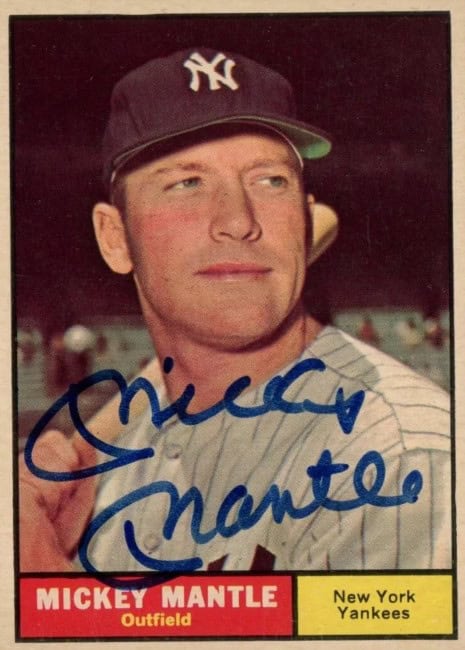
Building a Mickey Mantle collection means engaging with one of the hobby’s most rewarding challenges. There is no single path in. Collectors with serious resources chase the 1952 Topps or the 1951 Bowman rookie, pursuing grades and provenance in a market where condition differences translate to hundreds of thousands of dollars. Collectors with more modest budgets find tremendous satisfaction in the 1956 Topps or the 1957 Topps. Those cards \deliver genuine beauty and historical weight at prices that make them actually achievable.
What makes Mantle’s baseball card universe especially compelling is how the list above barely scratches the surface. Dozens of additional issues – the 1955 Bowman, the 1961 Topps, the 1962 Topps, multi-player subsets, All-Star inserts, and regional food issues from coast to coast – fill out a collecting universe that rewards patience and curiosity in equal measure. The hobby’s strongest advice for anyone entering this space is to focus on condition, buy graded for expensive purchases, and approach any ungraded copy of the 1952 Topps Mantle with serious skepticism.
Ultimately, the appeal of Mickey Mantle cards is inseparable from the appeal of Mickey Mantle himself. He was the player who inspired a generation to collect and made the hobby feel important. His legacy continues to drive prices upward decades after his retirement. Every card on this list carries a piece of that story.