
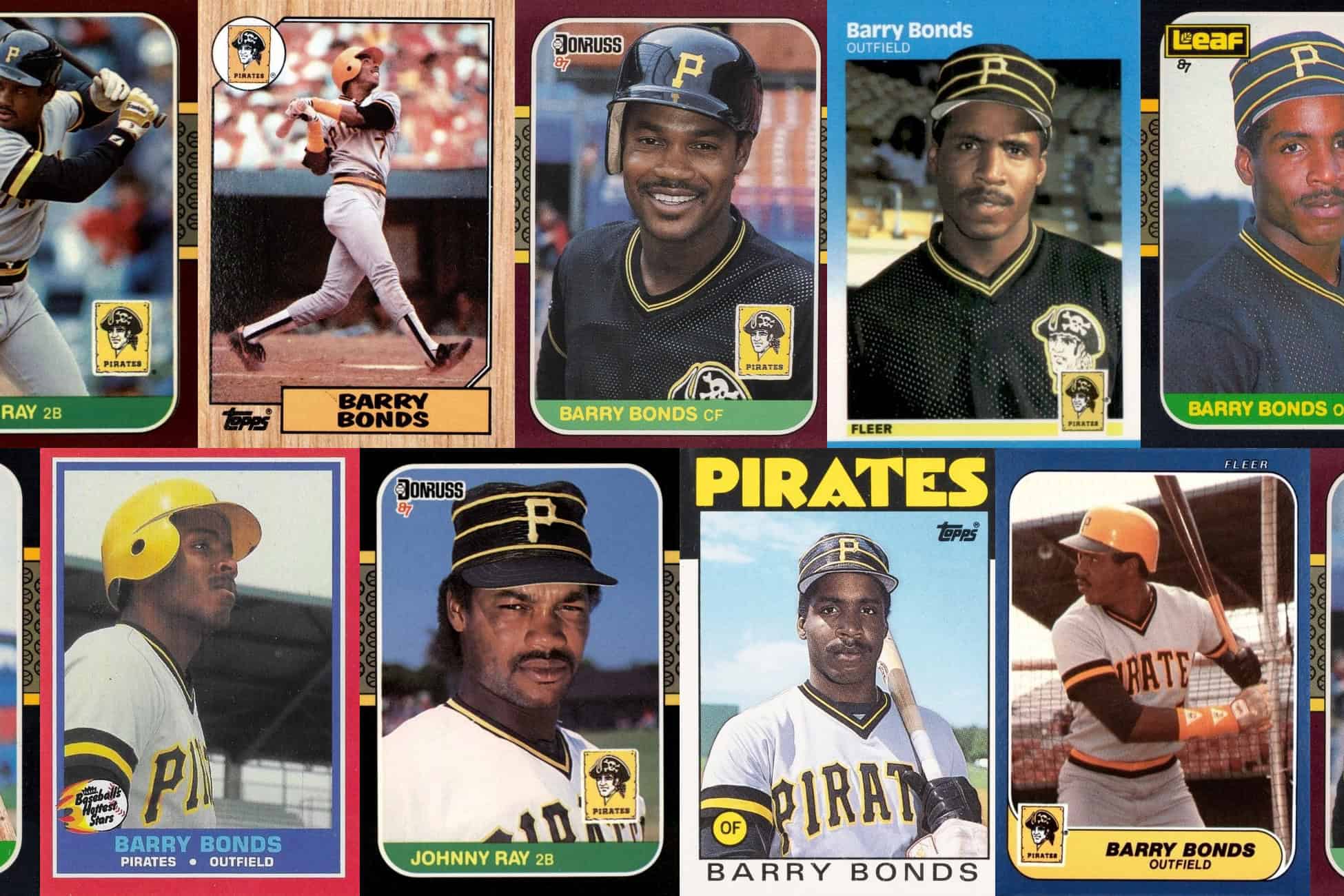

Some baseball cards earn their place in hobby history through breathtaking photography, iconic design, or the sheer greatness of the player pictured. And then there is card #163 from the 1987 Donruss Opening Day set – a card that made history precisely because it pictures the wrong player entirely. The 1987 Donruss Barry Bonds Opening Day error, which mistakenly features a photo of Pittsburgh Pirates second baseman Johnny Ray, stands as one of the most fascinating and collectible error cards of the modern era.
For collectors who lived through the 1980s card boom, this error carries a legendary status. Word traveled fast in hobby circles that a Barry Bonds card existed with someone else’s face on it, and the hunt was on. Decades later, that hunt continues. The card sits at the intersection of two powerful forces in the hobby – rarity and star power – and the combination makes it one of the most compelling cards of its generation.
To fully appreciate this error, it helps to understand the world of baseball cards in 1987. The hobby was in the middle of a production frenzy. Donruss, Topps, and Fleer were churning out enormous quantities of cards to meet surging collector demand, and quality control sometimes suffered as a result. The 1987 Donruss Opening Day set was a specialty release – something fresh and exciting for collectors who wanted more than the flagship set could offer.
What Is the 1987 Donruss Opening Day Set?
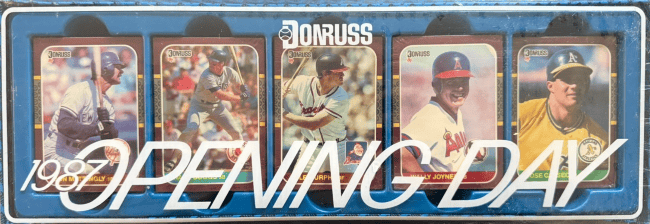
In 1987, Donruss issued a set of 273 cards after their regular issue set was released. The Opening Day set featured every player who was in the starting lineup for all 26 teams on Opening Day of the 1987 season. The concept was clever. Rather than a general checklist, this set told a very specific baseball story – who started the new season, on what team, and where they batted in the lineup.
The design borrowed from the standard 1987 Donruss set but swapped the signature black borders for a maroon treatment. That maroon border, while visually distinctive, would later become a significant factor in the error card’s value – more on that shortly. The set arrived as a factory set rather than packs, which turns out to be a crucial detail in the error card’s story.
In 1987, Barry Bonds was playing his first Opening Day game for the Pittsburgh Pirates. After batting .223 with 16 homers, 36 steals, and 65 walks as a rookie in 1986, he was batting lead-off and playing center field at Shea Stadium against the New York Mets on April 7, 1987. Johnny Ray, who is seven-plus years his senior, batted third and was at second base. Both players made the Opening Day set. Both were Pirates. And that proximity – cards #162 and #163 in the same set – is central to how this error happened.
How Did the Error Happen?
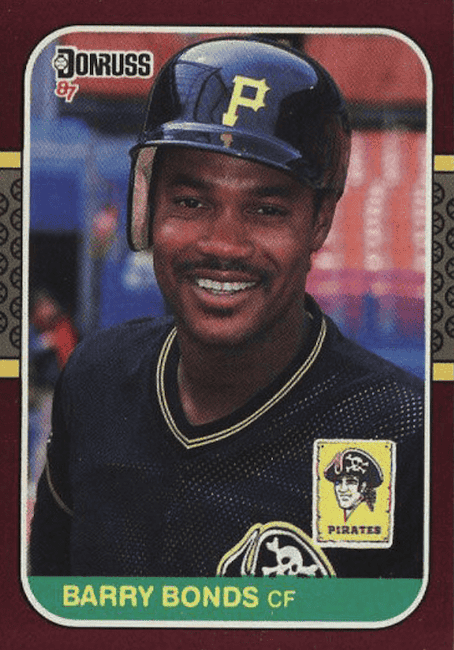
Despite that fact, the company mistakenly used a photo of 30-year-old Johnny Ray on card #163 featuring Bonds. That was a tough miss because card #162 was a card of Ray, so quality control did not notice that the same player was pictured twice in a row in the set. Ray had been a regular in Donruss sets since 1982, so he should have been a familiar face.
The most plausible explanation is a straightforward production mix-up. Someone assigned the wrong photo file to the wrong card slot, and the error passed through multiple review stages without getting caught. Donruss had a card of Barry Bonds in their 1986 “The Rookies” set, as well as their regular issued 1987 set, so they knew what the 22-year-old future star looked like at the time. This was not a case of mistaken identity because no one at the company recognized Bonds. They simply sent the wrong image to the wrong card.
As with most error cards, questions were asked whether Donruss had purposely produced an error card to boost value. Unlike some error cards, there was no official comment on the Bonds Opening Day error card, so all we are left with is speculation. Most collectors agree that this error card was not deliberately created. One important piece of context supports the accidental theory: in 1987, Bonds was not yet the superstar collectors would later come to worship. Other 1986 rookies – Jose Canseco, Wally Joyner, Will Clark – were generating far more buzz at the time. There was little strategic incentive to manufacture a Bonds error.
The Correction
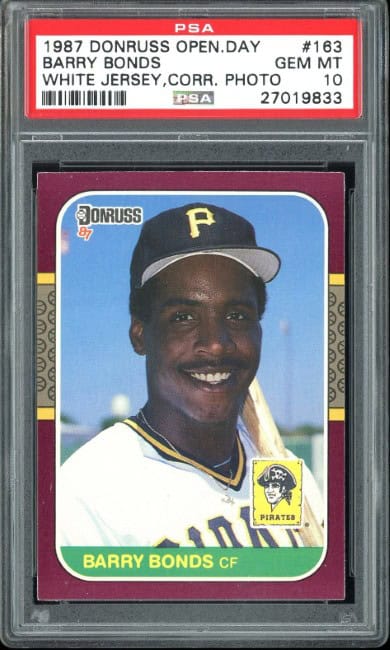
Photo errors happen, so the card of Bonds featuring Ray was released to the public. It was caught fairly quickly, relatively speaking, and Donruss fixed the error. The corrected version shows Bonds in his white Pirates uniform, smiling – and it remains the far more common card in the set today. These errors only turned up in factory sets, and all cards pulled from packs had the corrected photo. That distribution detail explains why collectors in the pack-opening crowd had never seen the error firsthand.
How Rare Is the Error Card?
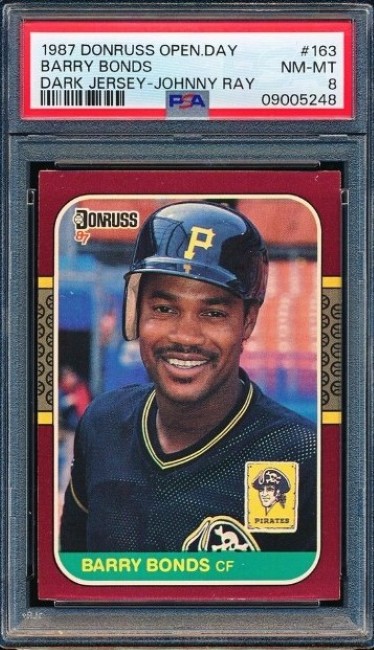
This is where the story gets genuinely remarkable. Many collectors estimate only 1-2% of the production was released before Donruss corrected card #163, making the error version one of the most coveted 1980s baseball cards.
The graded population data tells the story clearly. PSA has assessed nearly 3,000 examples of Bonds’ corrected rookie card but only 160 examples of the error version that features Ray. Even accounting for the fact that collectors grade error cards at a higher rate than common cards, that ratio underscores how genuinely scarce the error version is.
Prior to the entire world scrambling for anything 1986-1987 Barry Bonds, this card was almost mythical – it never showed up for sale and there were staggeringly low estimates on its print run. Hobbyists on collector forums describe it as the kind of card that circulates in whispers – everyone knows it exists, but few have held one in their hands.
Grading the card in high condition adds another layer of difficulty. Because of the full bleed maroon border, few examples surface in high grade. Maroon borders show chipping and wear at the corners very quickly, and even cards that spent years in a binder or factory set box show edge wear under grading-quality scrutiny.
What Is the Error Card Worth?
Values for this card vary significantly based on condition, and the gap between grades is steep. This rare error card is one of the most valuable Bonds cards, and both PSA 9s and 10s are genuinely tough to find. The universal graded population sits around 363 total submissions across all grades.
For ballpark figures, PSA 10 copies have sold for around $5,000, while PSA 9 copies have reached approximately $2,500. Lower-grade raw examples still carry meaningful value, with ungraded copies in presentable condition regularly fetching hundreds of dollars.
The card’s value has held up over time despite Bonds’ complicated legacy. His ongoing Hall of Fame exclusion – tied to the performance-enhancing drug era of the late 1990s and early 2000s – has historically suppressed prices on his cards relative to other all-time greats. Yet even with that headwind, the combination of star power and genuine scarcity keeps the error card valuable regardless of where Bonds stands in the broader HOF conversation.
It is also worth noting that Bonds’ regular cards are trending upward. His PSA 10 1987 Donruss rookie card saw a year-over-year value increase of over 200% heading into 2025, a sign that collector appetite for his early cardboard is growing. Rising tides lift all boats, and as his mainstream rookie cards climb, the already-scarce Opening Day error tends to follow.
How Collectors Feel About the Error Card
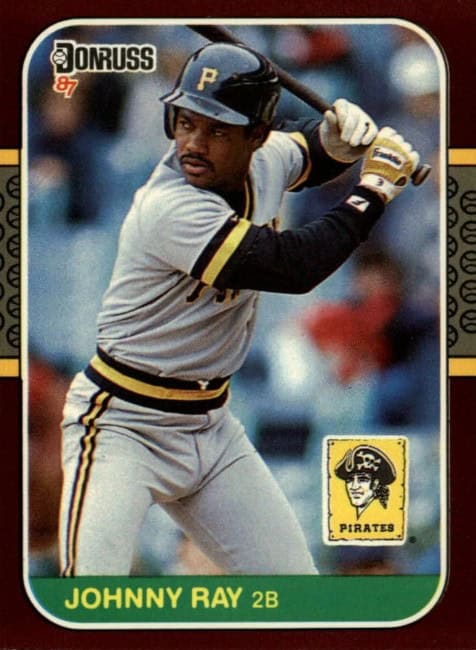
Few cards in the 1980s hobby generate the kind of emotional response this one does. One thing that fascinates many collectors is that people will place so much value on a card that does not even depict the player it purports. That observation captures something genuinely unusual about this piece. Collectors are not paying for a great photo of Barry Bonds. They are paying for the history, the story, and the rarity tied to a name printed on cardboard.
It did not take long for rumors of a Barry Bonds card with Johnny Ray’s picture to spread. However, while rumors circulated, many collectors were unsure of what the error card even looked like – largely because the card was so hard to find. That air of mystery lasted for years, particularly for collectors who had only heard about it through hobby publications or word-of-mouth at card shows.
Collectors also appreciate the historical layering. The card captures two Pirates teammates at a specific moment in time – Opening Day, 1987 – and the error makes that moment stranger and more memorable than any correct card could. Johnny Ray was a solid professional in his own right, a two-time All-Star who played 10 seasons in the majors. He is not an embarrassing face to appear on a Bonds card. He is simply the wrong one.
Other Barry Bonds Rookie Cards Worth Knowing
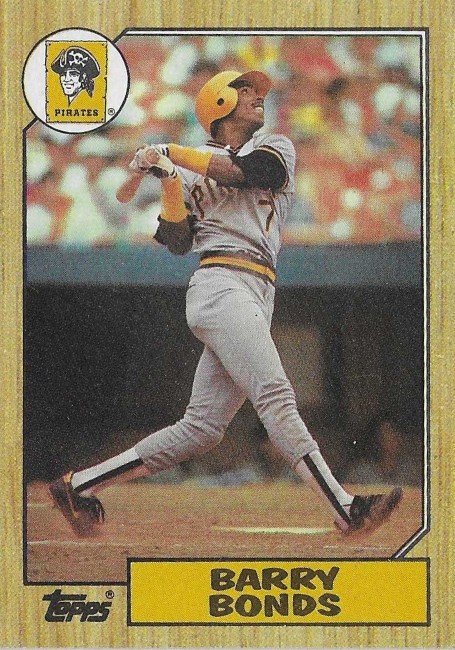
The Opening Day error is the crown jewel of Bonds’ early cardboard, but his rookie-era checklist is deep and worth exploring. Here are the key cards collectors target:
- 1987 Donruss #361: The standard flagship Bonds rookie card. Black borders make high grades challenging, but the card is affordable raw and a cornerstone of any Bonds collection. PSA 10 examples have been climbing toward the $500 range.
- 1987 Topps #320: The most widely recognized Bonds rookie, featuring the wood-grained Topps design. Extremely common in lower grades but legitimately difficult to find in PSA 10.
- 1987 Fleer #604: A clean, visually appealing card that carries similar value to both the Topps and Donruss versions – a reliable entry point for new Bonds collectors.
- 1987 Fleer Glossy #604: Issued exclusively in a tin factory set on higher-quality glossy stock and in lower volume. A step up in rarity and value from the standard Fleer version.
- 1987 Leaf #219: The Canadian version of Bonds’ Donruss rookie card. Lower print numbers and relative obscurity make this an overlooked option with upside for collectors paying attention.
- 1986 Topps Traded Tiffany #11T: Limited to around 5,000 copies and printed on high-quality glossy stock, this is one of the rarest Bonds rookies. PSA 10 copies are exceptionally scarce, and the card is prone to yellowing over time, which makes high-grade examples all the more valuable.
The 1987 Donruss Opening Day Corrected Version
The corrected #163 – the one with the correct picture – is worth acknowledging on its own terms. The design is essentially the same as the main 1987 Donruss Baseball set, save for the maroon borders. It also earns bonus points for being one of the few early Barry Bonds cards to show him smiling.
The standard corrected Opening Day version has a graded population of around 5,000, which is relatively low for a card from this era. PSA 10 examples are still accessible at around $200. Collectors often pair the corrected card with the error version as a variation set – owning both tells the full story of the printing mistake and makes for a compelling display.
Why This Card Matters Beyond Its Price Tag
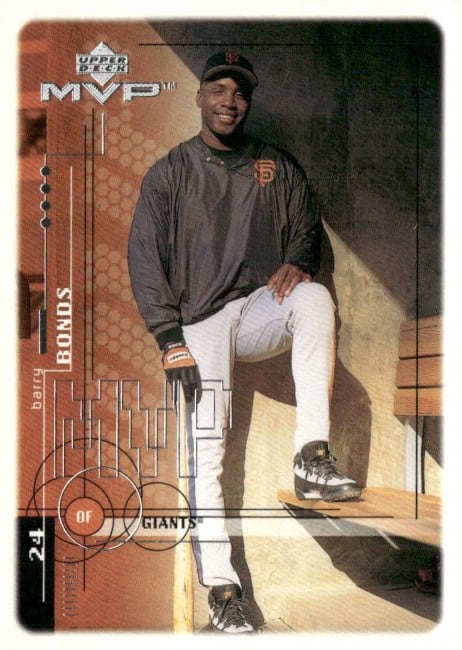
Error cards occupy a unique space in the hobby. Most collectors understand that card errors are accidents – quality control failures born out of deadline pressure, rushed production, or simple human oversight. What elevates the best error cards above mere curiosities is the combination of who is involved and how hard the card is to find. The 1987 Donruss Barry Bonds Opening Day error checks both boxes emphatically.
Barry Bonds finished his career as Major League Baseball’s all-time home run leader with 756. He won seven National League MVP awards, collected 14 All-Star selections, and earned eight Gold Gloves. His path from that 1987 Opening Day lineup card to his eventual place in baseball’s statistical record books represents one of the sport’s most dramatic career arcs. His links to the possible use of performance-enhancing drugs have clouded his Hall of Fame candidacy, but his legacy on the field is undeniable – and so is the collector interest in his early cards.
The Johnny Ray error is not simply a printing mistake. It is a time capsule from a specific April day in 1987, before anyone outside Pittsburgh took Bonds seriously as a future all-time great. The card rewards the collector who finds one not just with a valuable piece of cardboard, but with a story that connects to baseball history in a genuinely surprising way.
Conclusion
The 1987 Donruss Barry Bonds / Johnny Ray error card stands as proof that accidents can become legends. What started as a photo mix-up in a printing facility became one of the most sought-after cards of the 1980s, and its reputation has only grown as Bonds’ career legacy – however complicated – cements itself in baseball history. The card reminds collectors that rarity and story drive value just as powerfully as condition and grade.
For collectors looking to add this card to their holdings, patience is essential. The error surfaces infrequently on the major auction platforms, and high-grade examples attract competitive bidding. Buying raw carries grading risk given the maroon border’s tendency to chip. Buying graded costs a premium but eliminates the uncertainty. Either way, the investment reflects something real – a card that genuinely cannot be easily replaced because so few of them exist.
The hobby thrives on stories like this one. A 22-year-old Pittsburgh Pirate named Barry Bonds steps into the Opening Day lineup at Shea Stadium in April 1987, and someone on a production floor puts the wrong face on his card. Decades later, collectors are still searching for that mistake. That is the strange and wonderful logic of baseball cards – and the 1987 Donruss Barry Bonds Opening Day error card is one of the hobby’s best examples of it.