
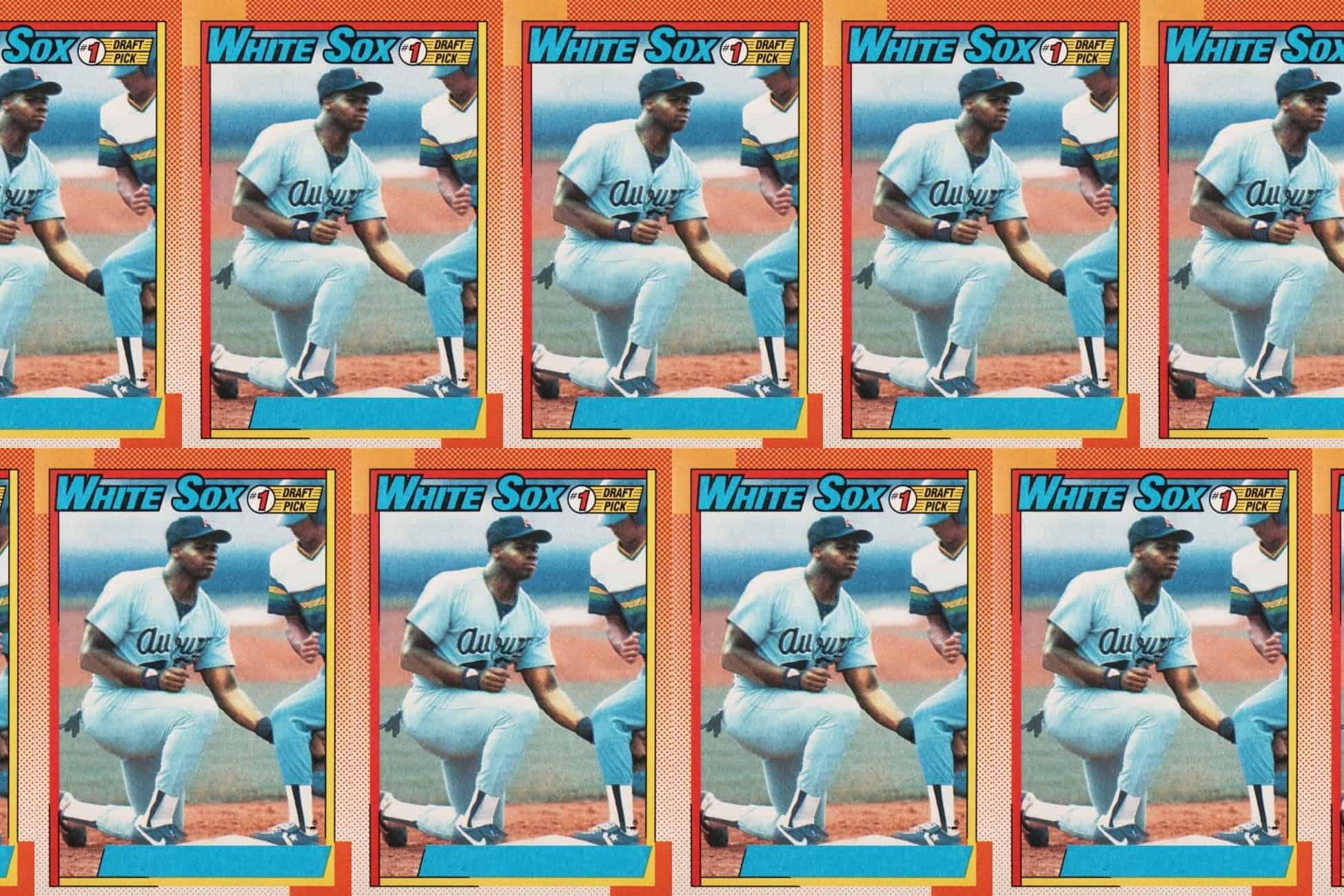

The hobby has produced thousands of error cards over the decades, but few carry the combination of rarity, star power, and sheer backstory that the 1990 Topps Frank Thomas No Name on Front ( NNOF) card delivers. This single piece of cardboard has captivated collectors for more than 35 years, generating debate, driving auction records, and sitting proudly in some of the most serious collections in the hobby. If you follow the baseball card market at all, you already know its reputation. If you are just discovering it, get ready for one of the great stories in the modern card era.
Frank Thomas entered the 1990 Topps set as a highly touted prospect out of Auburn University. He had not yet played a major league game when the set went to press, but Topps included him in their debut series in his college uniform. What happened next was the result of a production mistake that nobody caught in time – and the collecting world has been grateful for that oversight ever since. The card is extraordinarily rare in any condition, and in high grade it is one of the most elusive pieces in the entire hobby. It commands prices that put most cards from that period – and many cards from any period – to shame.
This guide covers everything you need to know about the 1990 Topps Frank Thomas NNOF card – what it is, how the error occurred, which versions exist, what you should expect to pay, and a few fascinating footnotes that make this card even more interesting than its face value suggests.
What Is the Frank Thomas NNOF Card?
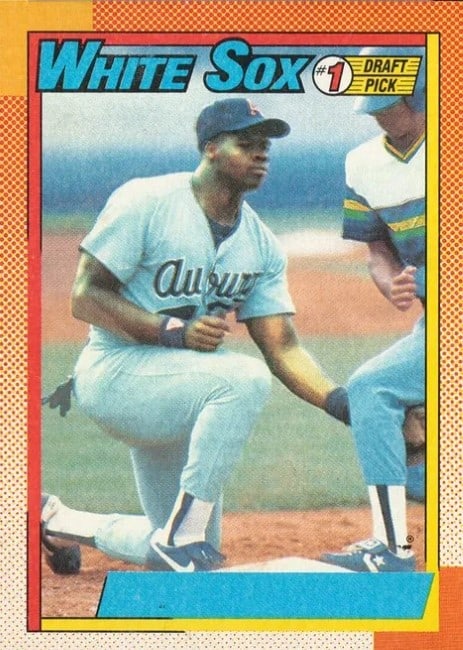
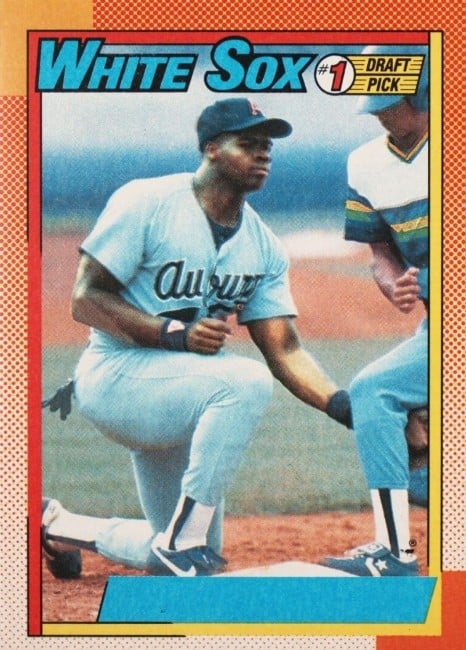
Card number 414B in the 1990 Topps set is where the story lives. The standard version of this card shows Frank Thomas in his Auburn uniform with his name printed across the bottom of the card front in the typical Topps style of the era. The error version – the NNOF, short for No Name on Front – is identical in every way except for one glaring omission: Frank Thomas’s name simply does not appear on the front of the card.
The card still features his photo, still carries the White Sox logo, and still looks like a standard 1990 Topps baseball card. The back of the card is identical to the corrected version, with his name, biographical details, and stats printed normally. The error is entirely on the front, where the name line is blank. At first glance, a casual observer might not notice anything wrong. But the second you place the two versions side by side, the difference jumps out immediately.
This is a rookie card by hobby convention, even though Thomas had not yet debuted in the majors. Topps printed him as a prospect, and his first-year cards in this set count as rookies. That matters significantly for the card’s value, since Frank Thomas went on to become one of the greatest hitters in baseball history – a first-ballot Hall of Famer who retired with 521 home runs and a reputation as one of the most feared sluggers of the 1990s. The NNOF version is rare enough that PSA has certified only around 291 copies total across all grades – an astonishingly small number for a card that came from one of the most mass-produced sets in history.
How Did the Error Happen?
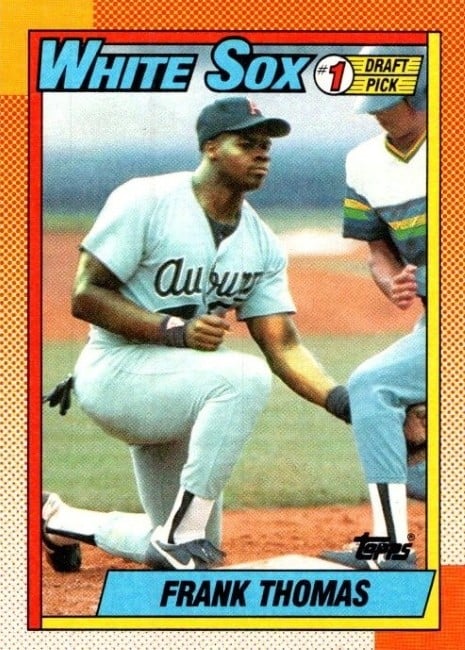
The short answer is that someone in Topps’ production process simply forgot to include Thomas’s name on the card front. The mechanics of large-scale card printing in this era involved multiple plates, layers, and press runs. A name element that should have been applied to the front of card 414 was left off, and that omission made it all the way through quality control and into packs without anyone catching it.
When the mistake was discovered, Topps issued a corrected version with Thomas’s name printed in its proper place along the bottom of the card front. By that point, a meaningful number of the error cards had already shipped to distributors and retailers. Those copies entered the market through wax packs and factory sets, mixed with standard cards, and most collectors who pulled them initially had no idea they were holding something unusual.
What makes this a better story than most printing errors is the player involved. Topps produced thousands of error cards over the decades, and the vast majority disappeared into obscurity because the players on them never amounted to much. Thomas was different. The printing slip that might have been forgotten forever instead became attached to the rookie card of a future Hall of Famer – and that combination of mundane production mistake and extraordinary player is exactly what turned a printing oversight into one of the hobby’s most recognized error cards.
The Two Versions: Error vs. Corrected
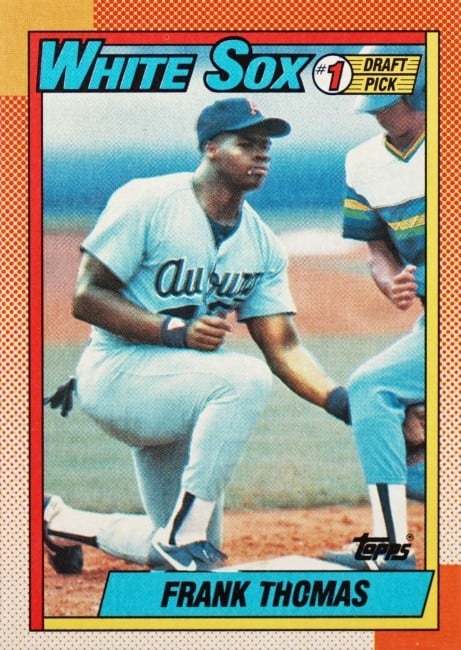
The 1990 Topps Frank Thomas card exists in two distinct forms, and understanding the difference is essential before you spend any money.
The error version (414B) has no name printed on the card front. This is the valuable card. The corrected version (414A) shows “FRANK THOMAS” printed along the bottom of the card front in the standard Topps style. The corrected version is extremely common – it was printed in far greater quantities and is worth almost nothing in raw condition, given the era’s massive print runs.
Here is a quick breakdown of the key differences:
- Error version (NNOF): No player name on card front; back is identical to the corrected version; this is the scarce and desirable version
- Corrected version: Player name appears on card front; extremely common; worth cents in most conditions; still a legitimate rookie card but with no significant premium
Both cards share the same card number. The “A” and “B” suffixes are conventions used by price guides and checklists to differentiate them. When buying or selling, always confirm which version you are looking at. A reputable grading company’s label will note the variation, but for raw cards, simply check the front for the name.
PSA also recognizes a third variation, which shows inconsistent black ink on the name panel. This is referred to as the “Partial Blackless” version.
What Are These Cards Worth?
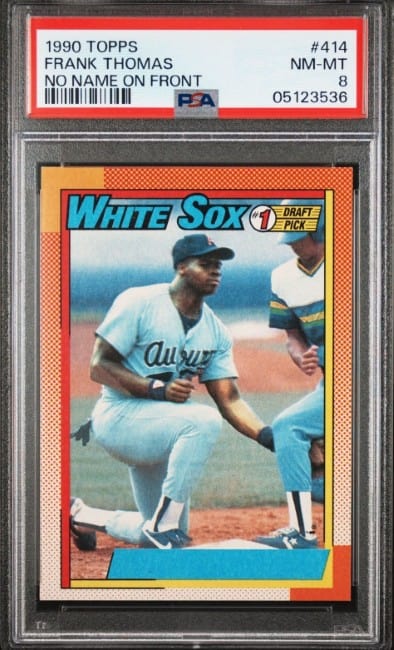
The pricing data from PSA makes clear just how seriously the market treats this card – and just how rare high-grade copies truly are. Even heavily worn examples command real money. The total graded population across all grades sits at around 291 cards – a remarkably small number for a card from a set printed in the tens of millions.
At the lower end of the grading scale, PSA 4 (VG-EX) copies have sold for around $4,644, and PSA 5 (EX) examples have averaged $6,666. Move up to PSA 6 and you are looking at recent sales around $6,088, while PSA 7 copies have sold for $7,999. These figures alone separate the NNOF from virtually every other card produced in the junk wax era, where most graded copies trade for pocket change regardless of condition.
The numbers get genuinely staggering at the top of the scale. PSA 8 copies have sold for over $12,000, with an average price of $12,000 and a population of just 100 cards. PSA 9 examples – with only 19 in existence according to the population report – have sold for $17,220, with an average price of $16,800. Then there is the PSA 10. Only one PSA 10 copy exists in the entire graded population, and it last sold for $170,400. That is not a typo. A single PSA 10 example of this card has traded for six figures, cementing its status as one of the most valuable junk wax era cards in the hobby.
The corrected version – the card with Thomas’s name on the front – sells for under a dollar in most grades and is essentially worthless from a premium standpoint. Never overpay thinking a Thomas rookie card is the NNOF without verifying first.
Population Reports and Rarity
The PSA population report tells you everything you need to know about why this card commands the prices it does. Across all grades, PSA has certified only around 291 total copies of the NNOF. For context, the corrected version of the same card exists in essentially unlimited supply. The NNOF survived the junk wax era’s massive print runs in remarkably small numbers – which is almost paradoxical given that the base set was printed in astronomical quantities.
The distribution within that small population skews heavily toward lower grades. Most copies that have been submitted show significant handling wear, the natural result of sitting in shoeboxes, binders, and penny sleeves for decades before collectors understood what they had. PSA 7 has a population of 50. PSA 8 has 100, and PSA 9 has just 19 copies in the world. And at the absolute pinnacle, there is exactly one PSA 10 on the planet, from the Dmitri Young Collection.
That single PSA 10 is the card’s crown jewel, and its $170,400 sale price reflects the near-impossibility of finding a flawless copy. The 1990 Topps printing process was not known for precision. Centering issues were rampant across the entire set, and the NNOF suffers from this as much as any card. Finding a copy with strong centering, four sharp corners, clean surfaces, and bright color is genuinely difficult – which is precisely why the PSA 10 population has never grown beyond one. This is an extraordinarily rare card in top condition, full stop.
NNOF Autographs & Tributes
Here is where the story gets genuinely fascinating. Frank Thomas has signed the NNOF card for collectors on multiple occasions, including through official memorabilia companies and at card shows. The autographed NNOF sits in a category of its own – it is arguably the most thematically appropriate autograph in the hobby. Thomas signing a card with his name missing from the front is the kind of irony that makes collectors smile. Given how few NNOF copies exist in the first place, a signed example is rarer still.
Authenticated autograph copies of the NNOF are exceedingly rare, so there is no set price point. If you want one of these, be patient and be selective. Raw signed copies with no authentication are risky purchases. Always insist on a verified signature from a reputable authenticator, and examine photos carefully before buying online.
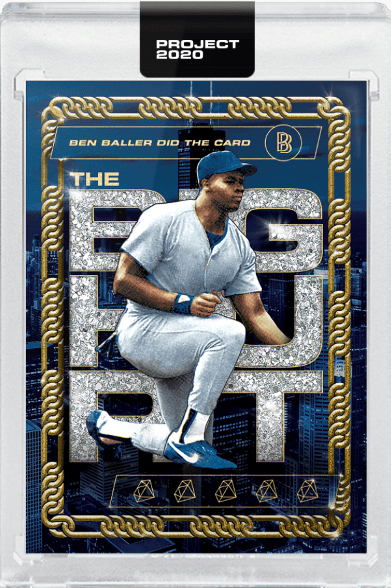
The Frank Thomas NNOF card was also part of Project 2020 – a set of 20 cards from different artists, honoring an iconic card. Artists such as Ben Baller and Fucci contributed to the project. This set renewed interest in the Thomas card and raised its value.
The Junk Wax Era Context
To fully appreciate the NNOF card, it helps to understand the collecting landscape it emerged from. The late 1980s and early 1990s saw card companies printing in enormous volumes to meet exploding demand. Collectors – and speculators – were scooping up complete sets and unopened wax boxes expecting huge future returns. The result was a massive oversupply of cards from this era that has kept most values near zero for decades.
The 1990 Topps Frank Thomas NNOF survived this environment because it combined two powerful forces: genuine scarcity within an otherwise common set, and an elite player whose career justified long-term demand. Most junk wax error cards from this period involve players who never made significant impacts, which limits their upside. Thomas is different. He is a Hall of Famer. The combination of a legitimate production variation on a first-year card of a legendary player – with a total certified population of fewer than 300 copies across all grades – is exactly what separates this card from the sea of worthless error cards that never found an audience.
Tips for Buying the NNOF
Buying the error version requires a few standard precautions that every serious collector should follow.
First, always confirm the error. On a raw card, look at the front. No name means error. Name present means corrected version. This sounds obvious, but hurried transactions have caught buyers off guard. Second, for any purchase above $100, consider buying only graded copies from PSA, BGS, or SGC. Graded holders lock in the condition and confirm the variation in print on the label. Third, check recent sold listings on platforms like eBay before committing to a price. The market for this card moves with Frank Thomas news cycles – Hall of Fame anniversaries, retrospectives, and media appearances can spike short-term demand.
Finally, be careful about counterfeit or tampered cards. The NNOF card has been faked by removing the name from corrected versions through chemical or physical means. A graded example eliminates most of this risk. On raw cards, look closely at the area where the name would appear for any signs of residue, discoloration, or surface inconsistency.
Why This Card Belongs in Your Collection
The 1990 Topps Frank Thomas NNOF is more than a production mistake. It is a documented moment where timing and printing converged to create something the hobby did not expect and has never quite replicated. The card tells a story that goes beyond cardboard – it captures the chaotic, high-volume production world of early 1990s card manufacturing and the career of one of the most dominant hitters the game has ever seen.
If you’re building an error card collection, it is an anchor piece – one of the few error cards from the junk wax era that commands genuine respect and real money. For Frank Thomas fans and White Sox collectors, it is an essential piece of the rookie card story, a variation that no complete Thomas collection should be without. For newer collectors learning about the hobby, it is a perfect case study in how scarcity and player significance interact to create lasting value even in the most oversaturated era of card production history.
The card is rare enough that most collectors will never hold a high-grade example in their hands. With only 19 PSA 9 copies and a single PSA 10 in existence, the top of the market belongs to a very small group. But the card’s range of entry points – from raw, lower-grade copies that still command hundreds of dollars to the six-figure PSA 10 – means the NNOF speaks to collectors at every level. That range is part of its enduring appeal.
The 1990 Topps Frank Thomas NNOF card is, simply put, one of the great stories the hobby has produced. Every copy you hold was touched by a production oversight that survived decades of storage and carries the name of a Hall of Famer – conspicuously, gloriously absent on the front. That absence is everything.
